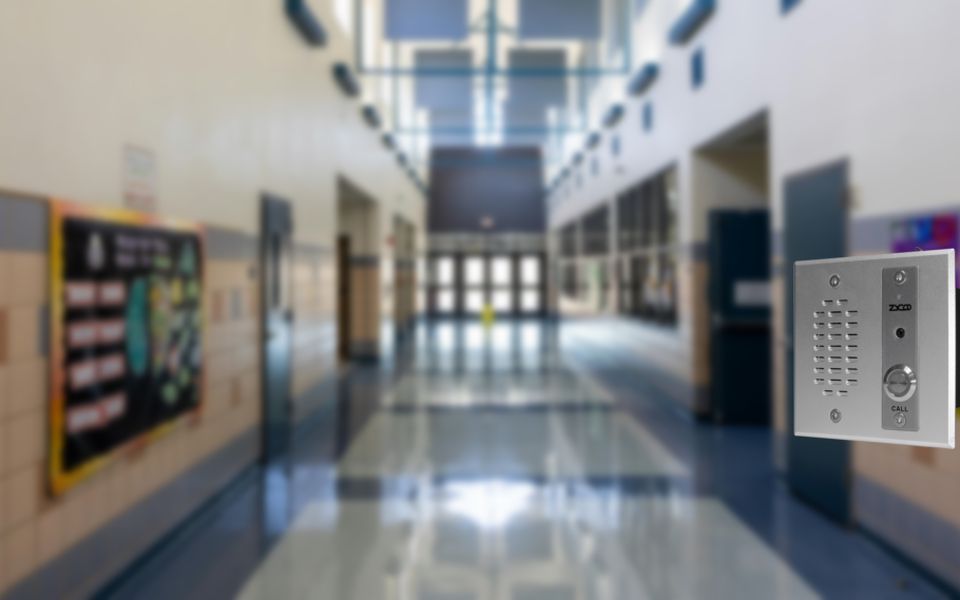
A PA speaker is a loudspeaker built to carry voice announcements, alerts, and background music to a group of people through a public address system. In a school, factory, hospital, transit station, or commercial space, it's the endpoint that turns a page from the front desk into speech people can understand across a corridor, a yard, a building, or a platform.
PA Speaker Meaning
PA stands for public address , and the term covers two contexts. In live sound, a PA speaker is part of a rig that reinforces a band, a presenter, or an event. Those setups get assembled for the occasion and packed away afterward.
This guide covers the second context: PA speakers installed in buildings and facilities. They stay in place for years, run through long days, and handle paging, scheduled announcements, and emergency messages.
How a PA Speaker Fits Into a PA System
An installed PA system moves audio through four stages. A source creates the message, such as a paging microphone, a SIP phone, a scheduled bell file, or a music feed. A control layer decides where the audio goes, whether that's an IP PBX, a paging console, or a platform like ZYCOO IP Audio Center that manages zones, schedules, and priorities. An amplifier raises the signal to speaker level. The PA speaker then turns it into sound.

The amplifier is the stage that varies most between designs. In a traditional system, one or more central amplifiers drive many passive speakers over speaker wire. In a network system, many IP speakers include their own amplifier and receive audio over Ethernet (often PoE), so a speaker cable run looks like any other network drop. Either way, the last link is the same: a speaker in a room or yard that has to be heard and understood.
Types of PA Speakers for Installed Use
Installed commercial PA speakers are usually grouped by form factor. The table shows where each type goes and why.
| Type | Typical placement | Why it's used |
|---|---|---|
| Ceiling | Offices, classrooms, corridors, lobbies | Even coverage from above; flush and unobtrusive. |
| Wall-mount | Corridors, classrooms, wards, waiting areas | Suitable when ceilings are high or unavailable; aimable. |
| Horn | Yards, loading docks, parking areas, school grounds | Long-throw, high efficiency for noisy or open spaces. |
| Column | Courtyards, walkways, plazas, long halls | Controlled vertical coverage for linear or open areas. |

To bring sound and visual notifications together, many public address system manufacturers introduced speakers with a visual layer . These add an LED strobe and, on some models, an LCD that shows text, a clock, or a countdown. They suit noisy plants, open concourses, and corridors where an announcement helps if people can see it as well as hear it. For more on how horn speakers work in outdoor and industrial paging, see our horn speaker guide .
Active vs. Passive and Analog vs. IP PA Speakers
Two separate questions get blended on spec sheets, so it helps to split them.
Active versus passive describes where the amplifier lives. A passive speaker has no amplifier and needs an external one. An active speaker, also called a powered speaker, has an amplifier built in.
Analog versus IP describes how audio arrives. An analog speaker receives a signal over speaker wire or a line connection. An IP speaker, also called a network speaker, receives audio as network packets, commonly over SIP or multicast, and decodes it at the speaker.
Any pairing can exist. A passive analog speaker on a constant voltage line is the classic installed PA setup. A powered speaker with a line-level input is active and analog. An IP speaker almost always includes its own amplifier, so it's active. A passive speaker can also join a network paging system when a network power amplifier sits in front of it and converts SIP audio to an analog output. Some IP speakers can even drive a passive extension speaker from their built-in amplifier, so two speakers share one network connection and one switch port.
PA Speaker Specs That Matter
These three specs shape most installed designs.
Sensitivity
Sensitivity describes how much sound a speaker produces from a given amount of power at a set distance. A more sensitive speaker needs less amplifier power to reach the same loudness, which adds up quickly when you're budgeting wattage across dozens of speakers or sizing a PoE budget. Read it alongside maximum SPL, and see our guide to SPL in IP audio for how loud a given space needs to be.
Power Handling
This is the continuous power a speaker can take without damage. For a passive speaker, it should line up with the amplifier output and the wattage you assign to each speaker. For an IP speaker, the amplifier already matches the driver, and the available PoE power often sets the practical output limit.
Voltage Distribution
Passive speakers connect in one of two ways. Low impedance wiring, often 4 or 8 ohms, connects speakers directly to the amplifier, like a home stereo. It suits a few speakers on short runs. Constant voltage, commonly 70 V (North America) or 100 V (Europe, Asia-Pacific, and many other regions), drives the line at a higher voltage and lower current. Each speaker has a transformer with selectable power taps, so you assign each one a wattage and keep the total within the amplifier's rating. This setup lets one amplifier feed many speakers across long cable runs with less loss, which has been used for commercial paging for decades. ZYCOO's network power amplifiers support both constant voltage and constant impedance speaker configurations, so a project can keep its existing analog speaker runs and add SIP paging on top.
Ingress Protection: IP Rating for Outdoor PA Speakers
The letters "IP" in a rating share initials with "Internet Protocol," which can confuse people in network audio. In this context, they stand for ingress protection, as defined in IEC 60529.
The rating has two digits. The first digit rates protection against solid objects and dust (higher = tighter). The second covers water. Higher digits mean more protection, and an X replaces a digit when that category wasn't tested. For an outdoor PA speaker on a pole, a loading dock, or in an open yard, both digits matter because dust, rain, and washdown spray can get into poorly sealed enclosures.
ZYCOO's IPS-H1 IP horn speaker is IP66-rated, protecting against powerful water jets and dust-tight, suitable for loading docks, yards, and transport stations.
Where ZYCOO IP PA Speakers Fit
ZYCOO's IP paging speakers cover the form factors above: ceiling, wall-mount, horn, and column units, plus multi-info speakers with LED strobe and LCD options. They register as standard SIP endpoints, so they work with ZYCOO IP Audio Center, CooVox IP PBX , or compatible third-party systems. Power arrives over PoE or PoE+ depending on the model, which keeps power and data on one cable.
The newer IPS series network speakers have a built-in microphone for two-way talkback and can adjust paging volume to ambient noise. Its ceiling, wall-mount, and horn models each pair with a matching analog extension speaker that shares the network connection and amplifier, which saves switch ports and cabling when two speakers cover adjacent spaces. Where a site already has analog speaker runs, a network power amplifier accepts SIP paging and drives them.
Picking a specific model depends on coverage area, ambient noise, power budget, and integration needs. Our IP speaker selection guide walks through that decision step by step.
FAQ
What is the difference between a PA speaker and a regular speaker?
A regular speaker, such as a home or desktop model, is tuned for music quality at one listening position. A PA speaker is built to make speech understandable across a larger area. That usually means attention to coverage pattern and efficiency, mounting hardware for ceilings, walls, or poles, and, in installed systems, a connection to a paging line or network. Outdoor and industrial versions add sealed enclosures with an ingress protection rating.
Do schools and facilities still use PA systems?
Yes. Schools use them for bell schedules, campus announcements, and emergency messages. Hospitals use them for daily announcements and emergency notifications, factories for shift and safety announcements across noisy floors, and transit sites for passenger information. Many of these sites now run PA over the IP network, so the speakers register as network devices and share cabling with the building's other systems.