The PA system in your facility was probably installed during a different era of the plant — a different floor plan, a different headcount, and different safety compliance requirements. Now it's a patchwork: amplifiers that no longer have replacement parts, zones that can't be addressed individually, and no integration path to the fire alarm panel that was added three years later. The system works technically, but not well enough.
Whether you're planning to select a new PA system for your manufacturing plants or upgrade the industrial PA system while keeping existing infrastructure where it still makes sense, we'll cover what's actually changed in industrial IP audio, the seven factors that determine whether an upgrade succeeds, how to match equipment to your specific zones, and the procurement mistakes that tend to show up two years after installation.
What's Changed in Industrial IP Audio
From Fixed-Zone Amplifiers to Network-Addressable Audio
Traditional analog PA infrastructure is built around amplifiers. Each zone gets its own amp, which means adding a zone means running new cable, finding rack space, and reconfiguring the entire signal chain. Zone management is a physical problem.
IP-based systems change this at the infrastructure level. Speakers and paging gateways connect to the existing network, and zone logic lives in software. Adding coverage to a new building wing means deploying endpoints on the network. For facilities that expand incrementally, this is the operational difference that matters most.
What's Actually Driving Upgrades Right Now
Most industrial paging system upgrades aren't being triggered by a desire for new features, but by the following three concrete pressures.
First, aging amplifier hardware is hitting end-of-support.
Second, stringent fire code and workplace safety compliance requirements that legacy systems can't meet.
Third, facility expansion has simply outrun the original system's design capacity.
If any of those three sound familiar, you're reading the right guide. You can also see the ZYCOO blog to learn more about how IP public address systems work for a broader overview.
What to Consider When Upgrading Your Industrial PA System
Backward Compatibility with Existing Analog Speakers
In most cases, the industrial paging system upgrade doesn't require a full rip-and-replace. Existing 70V or 100V analog speakers can typically be retained and integrated into an IP system through an IP paging gateway, which bridges the legacy speaker line to the IP network and makes those endpoints addressable from the management platform.
You can then deploy IP speakers in your highest-priority or highest-noise zones like workshops, loading docks, and production lines while keeping analog speakers in break rooms, corridors, and low-criticality areas. This approach protects existing capital investment and lowers the threshold for getting a project approved internally.

Zone Flexibility and Centralized Management
Industrial sites have fundamentally different audio requirements across zones. Break rooms need background music, production lines need targeted dispatch, and every zone needs to collapse into a simultaneous all-call the moment an emergency is declared. The system needs to support independent zone addressing and multi-zone broadcast without requiring a trained technician to operate it day to day.
PoE simplifies the deployment side considerably. IP endpoints powered over the same cable that carries audio data reduce wiring complexity across large facilities. On the management layer, platforms like ZYCOO's IP Audio Center and IP Audio Dispatch Console provide the zone control and broadcast routing that industrial environments need, without bespoke configuration for every new use case.

Environmental Ratings for Your Specific Zones
Outdoor areas, high-dust workshops, and environments near heavy machinery all impose conditions that standard indoor speakers aren't built for. IP65 or IP66 ratings are the baseline for outdoor and high-particulate zones; extreme operating temperatures and vibration resistance matter in foundry and heavy fabrication environments.
The mistake buyers make is selecting a single speaker model across the entire facility without mapping selections to zone conditions. The consequences aren't immediately visible: the speakers work on day one and start failing several months later in exactly the environments where broadcast reliability matters most.
Maximum SPL for High-Noise Work Areas
Ambient noise in active industrial environments typically runs between 85 and 100 dB(A). For a PA broadcast to be intelligible, not just audible, the audio signal needs to exceed that ambient floor by at least 10 to 15 dB. A workshop running at 95 dB ambient needs speakers capable of delivering 105 to 110 dB SPL at the listening distance.
The practical framework is straightforward: measure ambient noise under operating conditions, add the 10-15 dB intelligibility margin, and establish that total as your minimum SPL requirement for endpoint selection. For a more detailed treatment of acoustic design in noisy industrial environments, the ZYCOO post on designing IP communication systems for high-noise environments covers the design principles in depth.
Emergency Override and Fire System Integration
When a fire alarm activates, the Paging system needs to automatically cut all lower-priority audio and broadcast the evacuation message at full system volume across every zone simultaneously without manual intervention. This is a safety-critical requirement, and it should be treated as a qualification criterion rather than an evaluation criterion.
What integration actually requires: the PA system needs a dry contact input or SIP trigger that maps to the fire alarm panel's output, with configurable priority levels that execute the override within a defined response time. Verify this mechanism explicitly with any vendor you're evaluating, and confirm what the system does if a network failure occurs during an alarm condition.
VoIP and IP-PBX Integration
Supervisors and safety officers move around. Requiring them to locate a dedicated paging microphone to initiate a broadcast under operational pressure is a workflow problem. SIP protocol compatibility lets authorized personnel initiate PA broadcasts directly from an IP desk phone or a mobile SIP client, routed to the appropriate zones based on their permissions and configuration.
This also extends the useful life of your existing IP-PBX investment. If the facility already runs a SIP-based phone system, a properly integrated IP PA system works within that infrastructure rather than alongside it as a separate system to maintain.
Redundancy and System Uptime
Server redundancy and failover mechanisms don't show up in a demo; they only matter when something fails. In an environment where the PA system is part of the fire evacuation plan, that's a compliance and liability issue, not just an operational preference.
The mechanisms to ask about include hot standby server configurations, endpoint-level fallback behavior if the management platform goes offline, and UPS integration for power continuity.
Matching Equipment to Industrial Zones
High-Noise Production Floors and Workshops
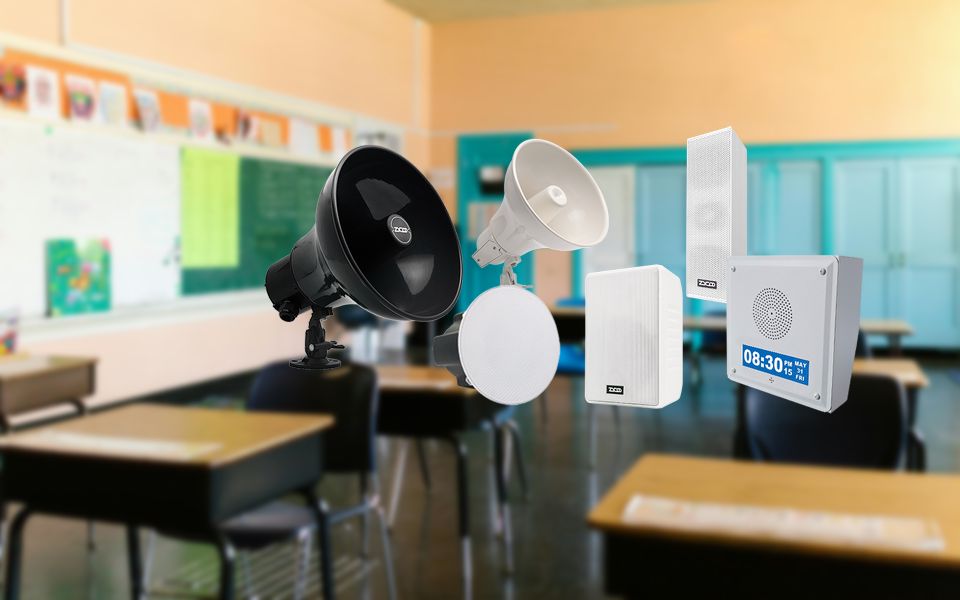
The right endpoint here is a horn speaker or a directional high-SPL speaker. The selection criteria are SPL rating (110 dB or higher for most active production environments), IP rating appropriate to the zone conditions, and wattage relative to coverage area. Ceiling speakers are designed for controlled acoustic environments; they're not adequate for a stamping press floor or a heavy assembly line, regardless of how many you install.
For logistics and warehouse environments that share some characteristics with production floors, the ZYCOO warehouse paging system post covers zone-specific speaker selection in that context.
Corridors, Offices, and Common Areas
Ceiling speakers or compact wall-mount speakers are appropriate here. SPL requirements are lower — typically 90 to 100 dB — and audio quality matters more than raw output. These zones are also where background music and scheduled announcements run during normal operations, so audio fidelity factors into the selection. Visual display integration can also supplement audio in corridors with heavier foot traffic.

Outdoor Areas: Loading Docks, Yards, and Perimeters
IP65 or IP66-rated horn speakers or weatherproof enclosures are the standard here. UV resistance and operating temperature range matter for outdoor installations exposed to direct sunlight in warm climates or sustained cold in northern facilities. In some installations, vandalism resistance is also a practical consideration for perimeter and gate areas.
Control Rooms and Dispatch Stations
The management layer is where operators initiate broadcasts, monitor zone status, and configure scheduled announcements. The key question here is how many zones need to be addressable from a single operator position, and whether the workflow requires pre-recorded message playback alongside live speech capability.
A network microphone console handles this at the hardware level with a purpose-built dispatch interface that gives operators direct zone control without navigating a PC-based software interface. For larger dispatch environments where operators need to manage multiple zones simultaneously, the IP Audio Dispatch Console provides a more comprehensive interface with multi-zone visual feedback.

Visual Alerting for Extreme-Noise Zones
In environments where workers are required to wear noise-canceling earmuffs during operations, audio broadcast alone won't reach them. Visual alerting — strobe lights or high-visibility beacons — needs to trigger simultaneously with the audio broadcast so that workers who can't hear the PA are still reached by the alert.
ZYCOO's IP speakers support integration with third-party strobe devices via relay output, which allows the visual alert to trigger from the same event that initiates the audio broadcast.

Five Procurement Mistakes That Drive Long-Term Cost
Specifying a Single Speaker Model Site-Wide
A speaker adequate for a break room is inaudible on a stamping press floor, and a horn speaker rated for workshop output is overkill for a corridor. Installing the wrong endpoint type in high-noise zones means the system fails its primary function in exactly the locations where broadcast clarity matters most.
Buying into a Closed Management Ecosystem
Some PA management platforms charge per-endpoint licensing fees for adding zones and some restrict third-party integration entirely, meaning your chosen PA system can't talk to your existing VMS or fire alarm panel without custom middleware that the vendor controls.
SIP-based open systems avoid these constraints: endpoints from different manufacturers can coexist on the same platform, and adding zones doesn't require vendor involvement.
Treating the Upgrade as a One-Time Event
Industrial facilities aren't static. Production lines get added. Buildings get annexed. Headcounts shift. A PA system designed for today's floor plan will be undersized within three to five years if scalability wasn't part of the original design, then requires a second procurement project.
Skipping Redundancy Because It Isn't Visible on Day One
Server redundancy and failover mechanisms don't show up in a product demo. They only matter when something fails. In an environment where the PA system is part of the fire evacuation plan, that's not just an operational oversight but a compliance exposure.
Ignoring the Integration Stack Until After Procurement
PA systems in industrial environments usually connect to fire alarm panels, VMS platforms, IP-PBX systems, and sensor networks that trigger automated announcements. Map your existing systems before you evaluate platforms, and verify compatibility explicitly rather than assuming SIP compliance means everything interoperates cleanly.
How to Move Forward
A guide like this can frame the decision, but it can't resolve the site-specific variables that determine the right configuration for your facility: the ambient noise survey across each zone, the network topology, the zone count, the fire alarm panel model, the compliance framework that applies to your industry. Those details matter, and they affect hardware selection, management platform configuration, and integration architecture.
ZYCOO designs and manufactures IP audio hardware specifically for the kinds of environments this guide describes — factories, logistics centers, and industrial campuses. If you're at the evaluation stage and want to see how a complete IP audio architecture maps to a manufacturing environment, the ZYCOO manufacturing solution page covers the application in detail.