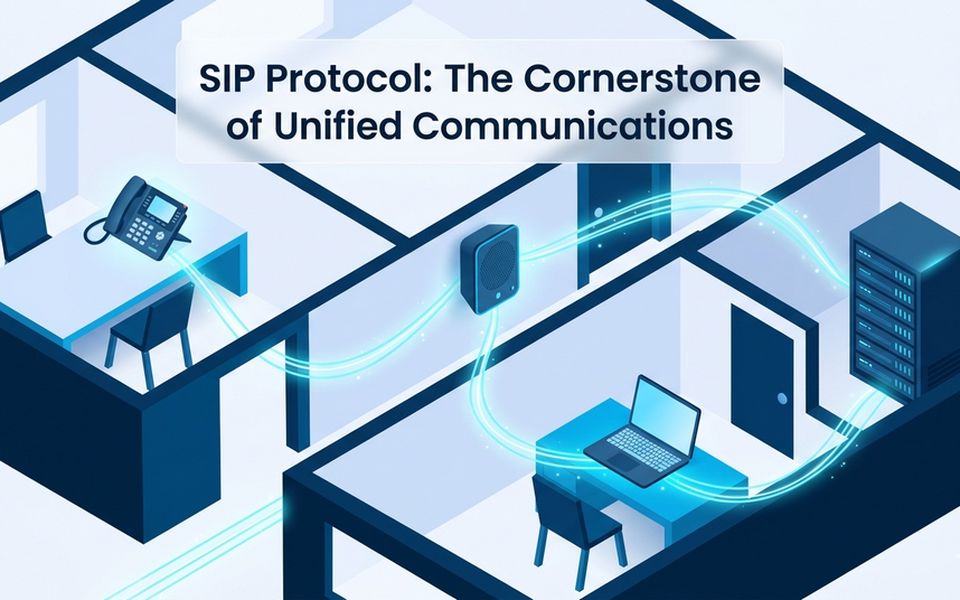
SIP stands for Session Initiation Protocol, and it's the signaling standard that starts, manages, and ends a real-time session over an IP network. That could be a phone call, a live page, or a video call. SIP never touches the actual voice or video itself. It just handles the handshake: who's calling, who's answering, and what happens next.
Traditional phone and paging systems used to run on separate, closed hardware, but SIP collapses them onto one signaling layer. An IP-PBX, a SIP paging gateway, and an IP audio server can all register as endpoints on that same layer, whether the device answering is a desk phone or a network speaker. Here's how an SIP session actually works and why it's become the shared foundation for IP telephony, IP audio, and paging alike.
What Is SIP Protocol & What It Actually Does
Formally, RFC 3261 defined and standardized SIP as an application-layer signaling protocol, built to create, manage, and end real-time sessions over an IP network.
Any phone, gateway, speaker, or intercom that speaks SIP is a user agent, the endpoint actually placing or answering a session. When that endpoint joins the network, it sends a REGISTER request to a SIP registrar, which is how the system knows where to find it later. Whether SIP is routing a phone call or triggering a zone page, it's running on those two roles underneath.
Once SIP finishes that handshake (who's calling, who's answering, and what media they've agreed on), RTP, or Real-Time Transport Protocol, takes over and carries the actual audio or video. SIP's job ends right where the media begins, and that handoff is exactly what makes SIP so easy to plug into different systems. It only ever has to manage the setup, never the stream itself.
A single SIP session can initiate almost anything real-time and voice-based:
- A voice call between two IP phones or softphones
- A paging broadcast to a specific zone of network speakers
- An intercom call between a door station and the front desk
- An emergency alert routed automatically through a PBX dial plan
- A background music stream to an IP audio zone
SIP is also an open standard set by the IETF, and no single vendor owns it. A SIP phone from one manufacturer can register to a PBX from another, a paging gateway from a third, and a SIP trunk from a fourth, all without any custom integration work between them. The protocol itself is the integration layer.
How Does the SIP Protocol Work?
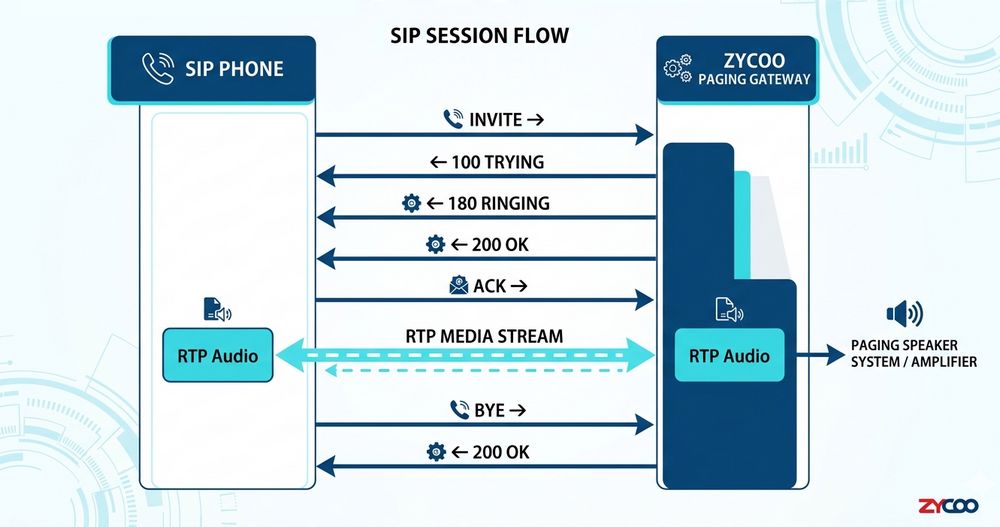
Registering gets a device on the map, but placing an actual call is a different exchange. Say one IP phone calls another: the caller's phone sends an INVITE, and the network answers back with a string of response codes telling it what's happening next. A 100 Trying means the request is on its way. A 180 Ringing means it reached the other end and the phone is alerting. A 200 OK means someone picked up, the caller confirms with an ACK, and RTP takes over from there. A BYE from either side, followed by a 200 OK, closes the session out.
Those codes aren't random numbers. They fall into classes worth knowing even outside a single call. 1xx means something's in progress, 2xx means success, 3xx means the session got redirected, 4xx means the request failed on the caller's end (a 404 for a bad extension, a 486 for a busy line), and 5xx or 6xx point to a problem on the server or the network itself. A PBX or a paging gateway logs these constantly, and reading them is usually the fastest way to find out why a call or a page didn't go through.
Paging runs on the same pattern, minus one step. A phone rings because the callee has to be alerted before deciding to answer. A paging endpoint usually skips that and auto-answers instead, sending back a 200 OK the moment the INVITE arrives without ever going through 180 Ringing. That's what lets a page start broadcasting instantly instead of waiting on somebody to pick up. Where those endpoints actually belong within the broader system is next.
How SIP Fits Into a Unified Signaling Stack
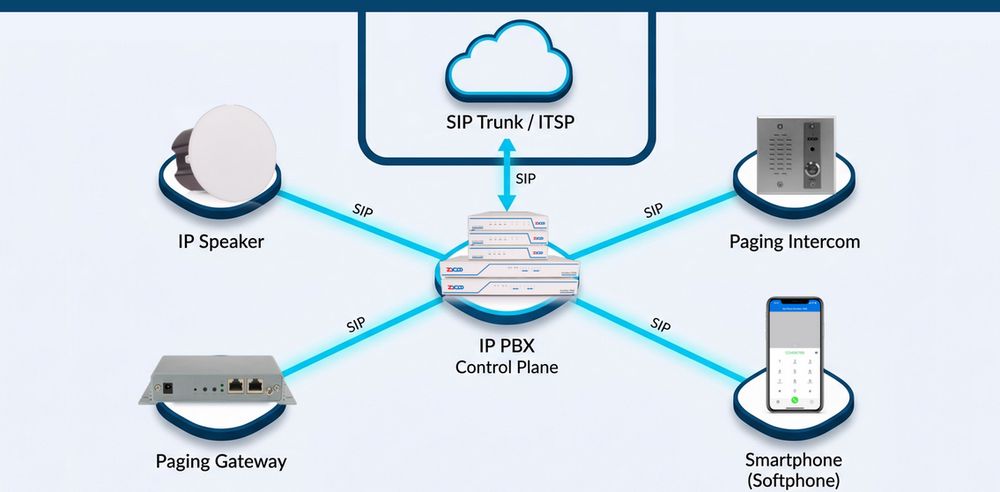
Every device in this stack registers with a registrar and speaks the same session language, whether it's a phone, a paging gateway, or an audio server. None of them need to understand each other's proprietary interfaces. They just need to speak SIP, and that alone turns a pile of separate hardware into one coordinated system. The PBX handles the routing intelligence; SIP is the common language everyone else uses to register, start a session, and end it.
A typical SIP-based stack looks like this:
- IP PBX: The call controller managing extensions, routing rules, and dial plans, and connecting to the PSTN via SIP trunks.
- SIP phones and softphones: User endpoints. Register to the IP PBX and behave as extensions.
- SIP trunk: The IP connection to a carrier, replacing analog or ISDN lines. Scales capacity through bandwidth, not physical ports.
- SIP paging gateways, intercoms, and IP speakers: Register as extensions too. They receive SIP sessions from the PBX and turn them into audio at physical zones.
- IP audio servers: Manage background music, scheduled announcements, and priority-based interruptions all triggered via SIP sessions.
Dial a paging extension from an IP phone, and the PBX routes a SIP INVITE to the gateway, the same mechanics already covered above. What happens next, which zones light up, at what priority, whether it cuts over background music, is application logic inside the paging system, not something SIP itself decides. SIP just opens the door.
Common SIP Protocol Use Cases
Unified Communications
The same INVITE and SDP negotiation covered earlier work for more than one media type at once, so adding a video codec alongside the audio codec in the offer turns that identical session into a video call instead of a voice call. SIP also lets a single identity, one extension, register from a desk phone, a softphone, and a mobile app simultaneously, so an incoming call rings every device at once, sometimes called SIP forking. Voice, video, and multi-device calling all run on the same session model that paging and broadcasting use too.
SIP Trunking
SIP trunking replaces a physical PSTN line with an IP connection to a carrier, so capacity is counted in concurrent sessions instead of ports. Getting one running usually means sorting out NAT traversal, a shared codec, and digest authentication with the carrier under RFC 3261, plus a fallback trunk or gateway for when the primary connection drops.
SIP Paging and Emergency Broadcasting
Paging takes the same SIP session model and turns it one-to-many. A paging gateway registers as an extension, auto-answers the instant it's called instead of ringing, and the audio fans out to every speaker in the zone over multicast. Emergency alerts use the identical trigger, just at top priority, so a pull station, a duress button, or a notification platform can fire a broadcast across every zone with no proprietary head-end involved.
Why SIP-Based Architecture Reduces Cost and Complexity
The business case comes down to three advantages that compound over the life of a system.
Infrastructure Consolidation
Telephony, paging, intercom, and broadcasting used to mean separate controllers, separate wiring, and separate vendor relationships for each one. SIP collapses all of that onto a single IP network. Devices register over the LAN, configuration happens in software, and adding a new endpoint means provisioning it, not running a cable out to a new analog head-end.
Scalable Expansion Without Architectural Rebuilds
Add a new building, a new paging zone, or a new site to a SIP-based system, and it's just SIP-compliant endpoints going into the dial plan. The architecture itself doesn't change. A legacy system usually means buying more capacity at the controller level instead, a fixed cost you pay regardless of how many endpoints you actually add.
That distinction adds up for anyone growing in phases: an initial rollout, then a few more floors, then a second campus. Each phase on a SIP system is an incremental add. On a legacy system, some of those phases turn into a capacity upgrade nobody planned for.
Vendor Independence
SIP's open-standard status already came up in the first section, so the short version: a ZYCOO IP-PBX works with SIP phones from Yealink, Polycom, or Cisco, and ZYCOO paging gateways register just as easily to Asterisk, FreePBX, 3CX, or Cisco. Swapping a SIP trunk provider doesn't touch anything on the internal network.
That doesn't mean every SIP implementation behaves identically. Feature sets, codec support, and how vendors handle edge cases like a mid-call re-INVITE all vary. But the baseline signaling interoperability SIP guarantees is enough to remove the hard lock-in that comes with proprietary systems.
The structural differences become clearer in a side-by-side comparison:
| Dimension | Traditional PBX + Separate Paging | SIP-Based UC Architecture |
|---|---|---|
| Adding a new site | Dedicated wiring, gateways, and hardware per site | Register new SIP endpoints over the network |
| Integration complexity | Custom/proprietary interfaces for each system | Standard SIP registration for all devices |
| Paging and telephony | Separate systems, separate controllers | Unified signaling layer (same SIP fabric) |
| Emergency broadcasting | Standalone controller, often proprietary | Triggered through PBX dial plan via SIP |
| Vendor flexibility | Often locked to one vendor's ecosystem | Any SIP-compliant device interoperates |
| Long-term maintenance | Expensive (multiple vendors, contracts, wiring) | Simplified (one architecture, one protocol) |
How ZYCOO Products Operate Within This Architecture
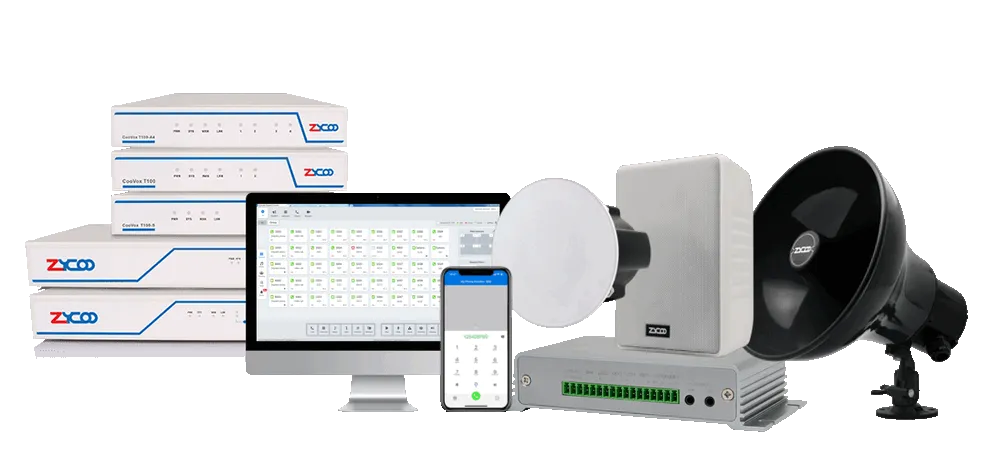
ZYCOO designs its IP telephony and IP audio product line to behave as native SIP endpoints. The CooVox IP PBX series, ZYCOO paging gateways, network speakers, intercoms, and IP audio servers all register, respond to SIP INVITE, and terminate sessions in compliance with RFC 3261. From any third-party PBX, a ZYCOO paging gateway is indistinguishable from a SIP extension.
This matters most in mixed-vendor environments, which describe the majority of real enterprise deployments. A hospital running third-party CUCM for telephony can deploy ZYCOO paging gateways and network speakers for overhead broadcasting without any middleware or protocol translation. An education campus using others' PBX can add ZYCOO IP audio zones, building by building, as budget allows, because each zone is just another SIP registration.
When a project grows over time, adding emergency broadcasting, then background music, then integration with a door access system, the ZYCOO architecture does not require a design change. New functionality is added as new SIP endpoints and new dial plan entries. The signaling model stays the same.
Conclusion
SIP builds one signaling layer and lets everything connect through it, making systems easier to expand, integrate, and maintain. It also shifts design thinking from hardware layout to network structure.
At ZYCOO, this model is considered a design baseline. IP telephony and IP audio products are designed to behave as native parts of the same UC system. Voice calls, paging, and broadcasting all live inside one signaling framework in the architecture.
If you are evaluating a SIP-based UC architecture for a specific project, contact us for a system design consultation.
FAQs
Q1. Is SIP the same as VoIP?
No. VoIP (Voice over IP) is the broad concept of transmitting voice over IP networks. SIP is one of the protocols used to set up and control those sessions. In modern enterprise UC deployments, SIP has become the dominant standard, but the two terms are not interchangeable.
Q2. Does SIP use TCP or UDP?
SIP supports both. UDP is common for internal LAN deployments where low overhead matters. TCP is used when reliability is required, particularly for larger SIP messages or traversal through certain firewalls. TLS over TCP (SIPS) is the recommended transport for any externally exposed SIP endpoint. Most enterprise PBX platforms support all three simultaneously.
Q3. Can ZYCOO paging gateways work with a third-party PBX?
Yes. ZYCOO paging gateways and network speakers register as standard SIP extensions to any SIP-compliant PBX. No custom middleware is required. ZYCOO's pre-sales team can validate compatibility for your specific PBX environment before deployment.
Q4. Does SIP handle paging zone management?
SIP handles session setup (initiating the broadcast and routing it to the correct paging gateway or audio server). Zone groupings, priority levels, preemption of background audio, and multi-zone distribution are configured within the ZYCOO paging application layer, not by SIP itself. SIP is the trigger; the paging system manages the output.
Q5. How does SIP interoperate with legacy analog paging infrastructure?
SIP analog telephone adapters (ATAs) and analog paging interface units can bridge SIP signaling to existing analog amplifiers and speaker circuits. ZYCOO offers hybrid gateway options for sites that need to retain legacy analog infrastructure while adding IP-based SIP control. This allows phased migration without a full rip-and-replace.