As communication infrastructure modernizes, with SIP-based telephony, centralized management platforms, and IP-integrated safety systems, the analog PA increasingly sits outside everything else. It still broadcasts but can't participate. It can't be reached from your communication platform. Pages are triggered from a fixed console, and adding a zone means pulling a new cable. When something stops working, there is no network visibility to diagnose it.
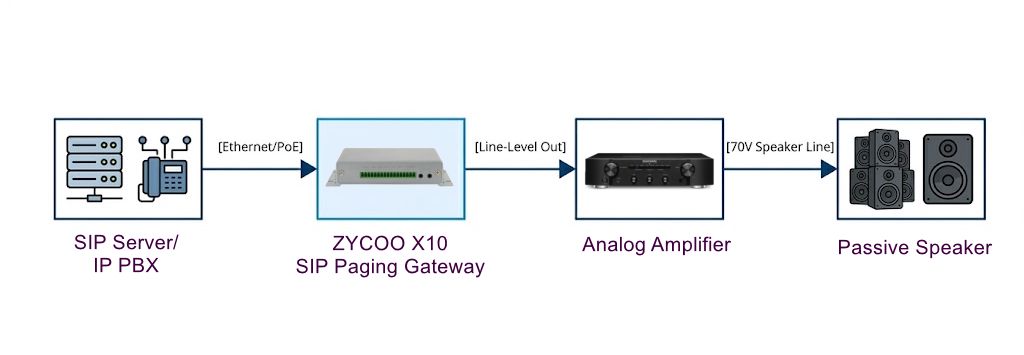
A SIP paging gateway bridges that gap. By registering to your IP-PBX or SIP server as a standard network endpoint, it converts incoming digital SIP or multicast audio to a line-level analog signal fed directly into your existing infrastructure. The speakers, the wiring, and the amplifier remain unchanged. What changes is that your PA system now gains a dedicated IP address on your network and can be reached, scheduled, and managed alongside every other modern communication devices.
This post covers how the bridging works, what to look for in a gateway, and how organizations across different industries are deploying it.
Why Your Analog PA Becomes a Liability, Not Just a Legacy
The structural challenge with traditional analog PA system is network isolation. The system runs on dedicated, constant-voltage speaker wiring that's physically separate from the local area network (LAN). It has no IP address, no SIP extension, and no web interface. There's no way for any software system—a communication platform, a scheduler, or a mass notification tool—to reach the PA.
That isolation has a practical cost. You can't trigger a page remotely, receive an alert when a zone stops responding, or integrate a PA announcement with an access control event. When something goes wrong, you find out when someone complains, not when a dashboard flags it. The PA functions as a closed system, and everything that needs to happen outside that system has to happen manually.
These constraints are manageable in small, stable environments. They become friction in larger facilities, multi-building campuses, or sites that need PA integrated with emergency broadcast or access control systems. The PA keeps working, but it increasingly sits outside the rest of your communication infrastructure, and that gap widens over time.
The analog PA isn't broken. It just has no way to talk to the rest of your infrastructure.
How a SIP Paging Gateway Works
A SIP paging gateway registers to a SIP server or IP-PBX as a standard SIP endpoint. Once registered, it has an extension. Any authorized device on the same SIP platform can dial that extension to trigger a page.
When the gateway receives a SIP call, it converts the incoming RTP audio stream to an analog line-level signal and delivers it to the amplifier's line input. The amplifier drives the speakers exactly as it always has. Nothing downstream changes.
Multicast works the same way. Configure the gateway as a multicast receiver for a given group address, and it joins that stream automatically whenever audio is sent to that group. No dedicated point-to-point SIP session needed per zone — which matters when you're managing multiple zones and want to avoid consuming a separate SIP license for each one.
Five Capabilities Worth Evaluating
Not every SIP paging gateway is built for the same environment. Here are the capabilities that tend to matter most when scoping a deployment.
- Built-in amplifier. Some gateways output line-level only, so you still need an external amplifier to drive the speakers. A gateway with an onboard power amplifier can drive passive speakers directly in smaller zones—a corridor, a break room, a secondary office—reducing the hardware footprint. ZYCOO's X10 includes a built-in amplifier, making it viable for both direct-drive deployments and line-out configurations, depending on zone size. For larger zones with existing dedicated amplifiers, line-out to that amplifier is still the right architecture.
- SIP and multicast support. The gateway must support both standard SIP protocols for direct phone-to-zone dialing and multicast RTP paging. Multicast capability ensures that a single audio stream can fan out across many endpoints simultaneously without overloading your IP-PBX or saturating network bandwidth.
- Two-way intercom. Some deployments need more than one-directional paging—a loading dock panel, a guard post, or an entrance where staff needs to initiate a callback. A gateway with a microphone input and two-way SIP audio handles both functions in one device. The X10 supports two-way intercom via a 3.5mm microphone input, which is worth confirming if intercom is part of the requirement.
- Peripheral I/O. A dry contact relay output lets the gateway trigger external devices when a page fires: a strobe light, a visual alerter, or an emergency bell circuit. A trigger input works in the other direction—a hardwired panic button initiates a page without anyone dialing. For safety-critical environments, this I/O capability is usually a firm requirement.
- ONVIF integration. Where IP cameras are already running under a VMS, ONVIF support lets the paging gateway respond to camera-triggered events. A perimeter breach or motion detection can automatically push an audio alert without additional middleware. The X10 supports ONVIF, which i relevant in facilities where surveillance and PA are expected to work together.
How Three Different Organizations Are Deploying It
Education: Hybrid Deployment Across Old and New Buildings
A school district is adding new buildings with IP speakers while retaining analog PA in older facilities. Rather than standardizing everything on IP immediately, the district uses SIP paging gateways to bring the legacy analog zones into the same management environment as the new IP speakers. Bell schedules, class change tones, and emergency lockdown announcements reach every building from a single interface. The older analog infrastructure stays in service and gets managed the same way as the new IP endpoints.
Manufacturing: Centralizing Multi-Zone Floor Paging
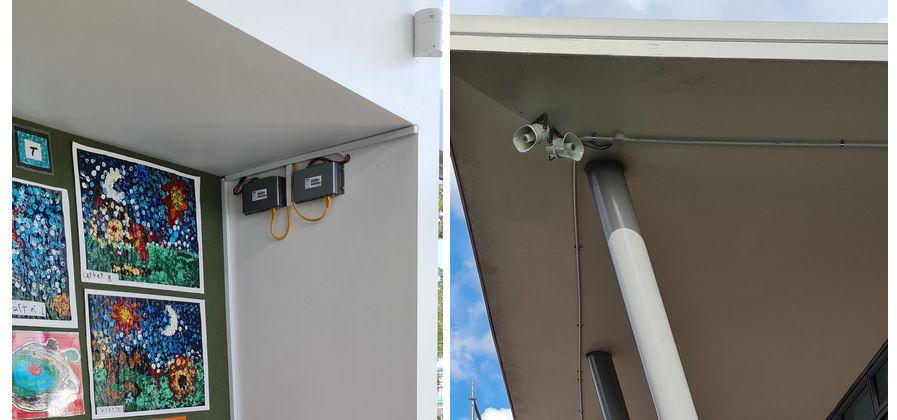
A manufacturing facility runs a 70V amplifier system across its production floor, warehouse, and offices. Communication has moved to a SIP-based platform, but triggering a PA page still requires someone at the local paging console. By deploying a SIP paging gateway per amplifier zone, with each registered to the central SIP server, supervisors can now send shift announcements, safety alerts, and emergency broadcasts from any authorized endpoint on the network. The speaker infrastructure stays in place. Zone control becomes part of the same platform managing everything else in the facility.
Logistics: Unified Control Across Multiple Distribution Sites
A logistics operator runs three distribution centers under one communication platform. Each site has its own analog PA system, previously managed independently. A SIP paging gateway at each location registers to the central SIP server. Shift change tones, safety announcements, and urgent pages are now dispatched from a single management console. There are no per-site PA operators needed, and the PA system at each site is now a managed, network-addressable endpoint rather than a local island.
The hardware bridging mechanism is the same across all of them. A SIP paging gateway registers the analog PA as a network endpoint, and the rest follows from that. The same approach applies in healthcare, hospitality, government facilities, and anywhere else analog PA and modern communication infrastructure coexist.
Phased Migration: Bridging Is a Permanent Strategy, Not a Stopgap
One assumption worth clearing up: a SIP paging gateway isn't a temporary solution you tolerate until you can afford to replace everything. For most organizations, it's the permanent architecture that's entirely reasonable.
The analog PA infrastructure and the IP management layer are independent of each other. Bridging one to the other doesn't commit you to replacing either. As individual zones are renovated or equipment ages out, you can transition them to IP speakers zone by zone within the same management platform. Or you don't, and the bridged analog zones continue operating indefinitely alongside newer IP endpoints.
ZYCOO's IP Audio Center manages both. Bridged zones handled by ZYCOO's X10 paging gateway and native IP speakers appear in the same interface, respond to the same schedules, and participate in the same emergency broadcast groups. When or whether to replace the analog hardware is a facilities and budget decision, not a system architecture constraint.
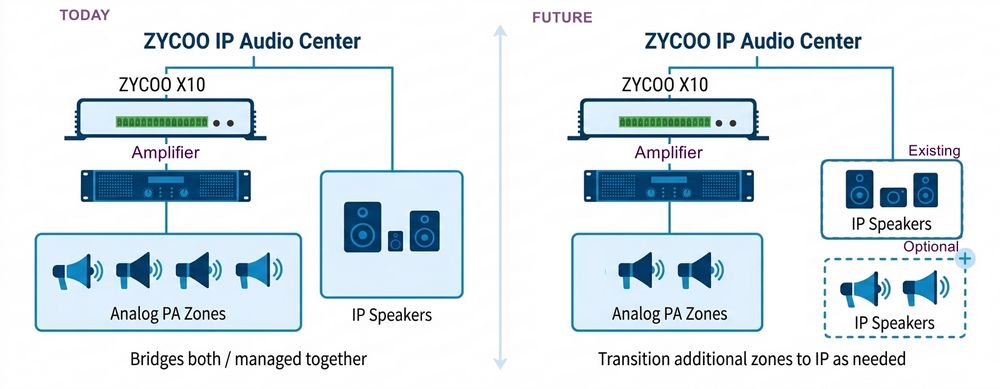
For greenfield projects or full facility renovations, starting with IP throughout is the cleaner approach. For any site with functional analog infrastructure, a phased migration starting with a SIP paging gateway is more practical and, in most cases, stays in service the longest.
Making the Analog PA Part of Your IP Communication Infrastructure
A SIP paging gateway doesn't upgrade the analog PA system. It integrates it. The speakers, the amplifier, the wiring — those stay exactly as they are. What changes is that the PA now has an address on your SIP network, which means it can be scheduled, managed remotely, triggered programmatically, and brought into the same operational environment as the rest of your communication infrastructure.
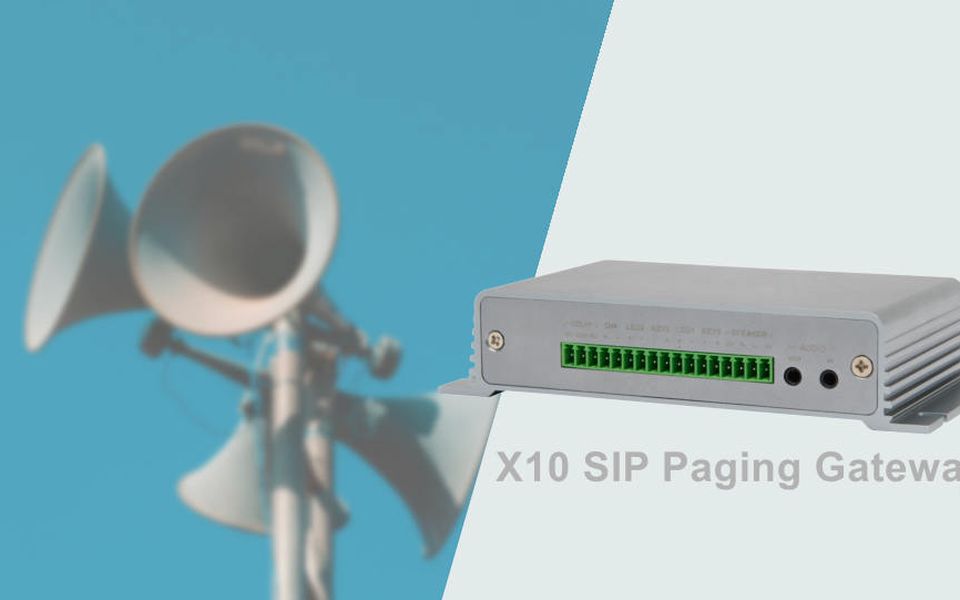
The ZYCOO X10 SIP paging gateway is built for this application. It supports standard SIP registration and multicast, includes a built-in amplifier for smaller direct-drive zones, and adds two-way intercom, dry contact relay I/O, and ONVIF integration, capabilities that matter in various deployments. It runs on PoE (IEEE 802.3at) and supports G.722, G.711, and Opus for HD audio quality over the amplifier output.
If your deployment needs migrating from legacy analog PA to IP-based, the ZYCOO X10 is ideal for a full IP paging environment. The product page has full specifications and datasheet downloads. If you'd rather talk through a specific deployment, ZYCOO's solutions team is available for pre-sale consultation.
Explore the ZYCOO X10 SIP Paging Gateway →
Talk to a Solutions Specialist →
Frequently Asked Questions
Q1. Can a SIP paging gateway work with any brand of analog amplifier?
Yes. The gateway outputs a standard line-level audio signal. Any analog amplifier with a line-level input will accept it, regardless of brand or age.
Q2. Does each paging zone need its own SIP license?
Not with multicast. Only the multicast sender requires a SIP registration. Additional gateways configured as multicast receivers join the stream without consuming separate SIP licenses.
Q3. Can the gateway deliver background music as well as paging?
Yes. Gateways that support MP3 streaming (including the X10) can run continuous background music through the analog amplifier between paging announcements.
Q4. Can a SIP paging gateway support two-way intercom, or is it one-way only?
It depends on the device. Gateways with a microphone input and two-way SIP audio support intercom use cases alongside paging. If an intercom is a requirement for any zone, confirm that the gateway supports it before specifying.