Getting a message to everyone in a warehouse isn't as simple as pressing a button. A shift supervisor needs to redirect the loading dock crew. A safety officer needs the floor cleared. Across a large warehouse of forklift noise, conveyor belts, and workers wearing hearing protection, that message has to actually land. For most facilities, the existing analog PA system was never really built for that job. It was built for a quieter, simpler era.
This post is about why more warehouse operators are moving to IP-based paging — and what that transition looks like in practice.
Why Warehouses Are Uniquely Difficult Audio Environments
Most commercial buildings are reasonably straightforward to cover with audio. Warehouses aren't. Four factors make them consistently harder than almost any other space.
High Ambient Noise Levels
An active warehouse floor regularly exceeds 85 dBA. This sits right at the threshold where OSHA requires hearing protection. A standard commercial speaker with low SPL output is effectively inaudible in that environment. Getting announcements reliably heard on an active warehouse floor requires significantly higher output and the right speaker form factor to project into the space.
Complex Layouts with Different Acoustic Zones
Modern distribution centers are a patchwork of acoustic challenges. You might have several completely different audio environments within a few hundred meters: a high-ceiling open floor with heavy equipment, a quiet carpeted office, a loading dock cycling between open and closed, and possibly cold storage. Each zone has different coverage requirements and different listener conditions. A volume level that reaches workers on the warehouse floor is overwhelming in the adjacent break room.
Mobile Workforce Moves Between Zones
The workers are rarely stationary. Forklift operators and pickers move through various sectors throughout their shift. Targeting announcements to specific areas matters — broadcasting facility-wide every time a dock-specific message goes out creates noise fatigue and eventually trains workers to ignore the PA.
Safety & Emergency Notification Compliance
OSHA 29 CFR 1910.38 requires employers to maintain an emergency action plan with a reliable means of notifying all employees of an emergency. A PA system with dead zones,single amplifier failure points, or insufficient output for a noisy environment doesn't satisfy that requirement in practice. When a fire or evacuation is underway, the paging system is often the only way to reach everyone at once.
The Limits of Analog PA in a Modern Warehouse
Traditional analog systems were the industry standard for a long time. However, as logistics facilities have become more data-driven and dynamic, the structural limitations of analog technology have become apparent.
Separate Infrastructure That Doesn't Share With Your Network
Traditional PA runs on dedicated cabling infrastructure that is completely isolated from the facility's data network. Every new zone requires new cable runs, sometimes hundreds of meters. When the floor layout changes, which it often does in distribution centers, the PA infrastructure either lags or gets rewired at high cost.
No Software Control
With analog, changing zones and speaker placements means physically rewiring terminals or adjusting selector switches. Scheduling a shift change tone means programming a hardware timer. There is no remote management or browser-based interface to adjust volumes or schedules on the fly. For a warehouse running multiple shifts across a facility that rearranges seasonally, that rigidity creates real friction.
No Integration with VoIP or Safety Systems
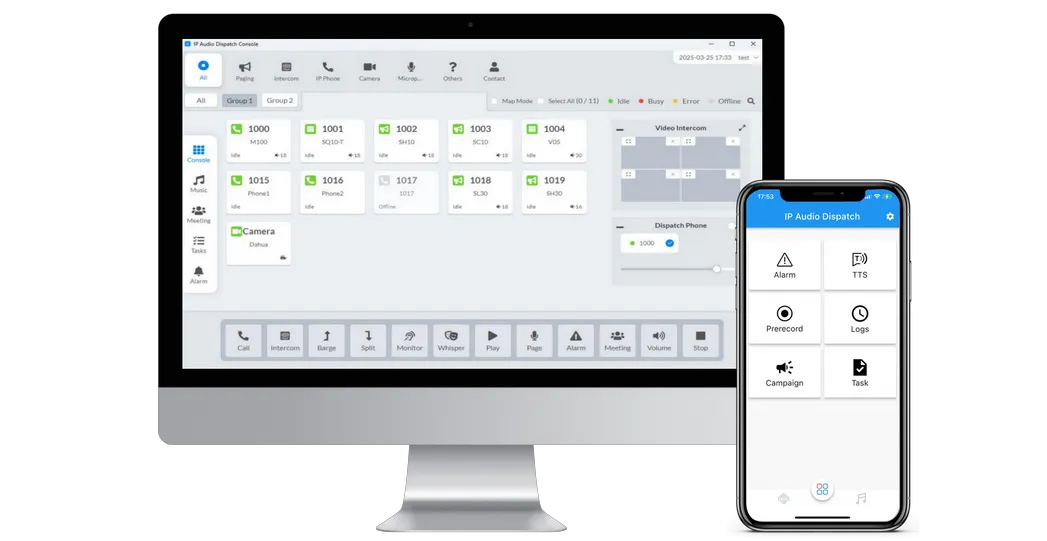
An analog PA is a standalone island. It has no connection to the VoIP phone system, the UC platform, or the fire alarm panel . This means a supervisor can't simply pick up a desk phone and dial an extension to reach the loading dock. This lack of integration is especially problematic for an OSHA emergency notification, as it prevents the PA from automatically responding to triggers from fire panels or security systems.
Single Points of Failure with No Remote Supervision
In a daisy-chained analog circuit, one amplifier failure takes down every speaker on that circuit simultaneously. Diagnosing which unit in the chain failed requires a physical walkthrough of the floor. There's no centralized fault view and no automatic alerting before a gap in coverage appears.
IP-based paging systems were built for exactly the architecture that warehouses now demand.
How an SIP-Based IP Paging System Works in a Warehouse
IP-based paging systems resolve most of these constraints structurally through a different architecture.
PoE: One Cable for Both Power and Audio
IP speakers powered by PoE (Power over Ethernet, IEEE 802.3af/at) receive both audio and electrical power through a single standard CAT5/6 cable from a PoE-capable network switch. No dedicated speaker wire, no separate power outlet at each location. Running a network cable to a ceiling mount is the same work as connecting a camera or an access point — any IT team can do it without specialist electrical contracting. Standard PoE (802.3af, up to 15.4W) suits ceiling and wall-mount speakers in quieter zones; higher-output horn speakers typically need PoE+ (802.3at, up to 30W).
SIP Registration: Connect IP Speakers to Existing Phone System
Each IP speaker registers to an SIP server or IP PBX as its own network endpoint, Exactly as a VoIP desk phone does. Any authorized user can trigger a paging announcement simply by dialing the speaker's SIP extension from a phone, softclient, or management interface.
Since SIP is an open standard (RFC 3261), ZYCOO speakers work with third-party platforms—3CX, Asterisk, and FreePBX—alongside ZYCOO's own IP Audio Center. The paging system stops being a separate silo and becomes part of the same unified communication environment as the desk phones.
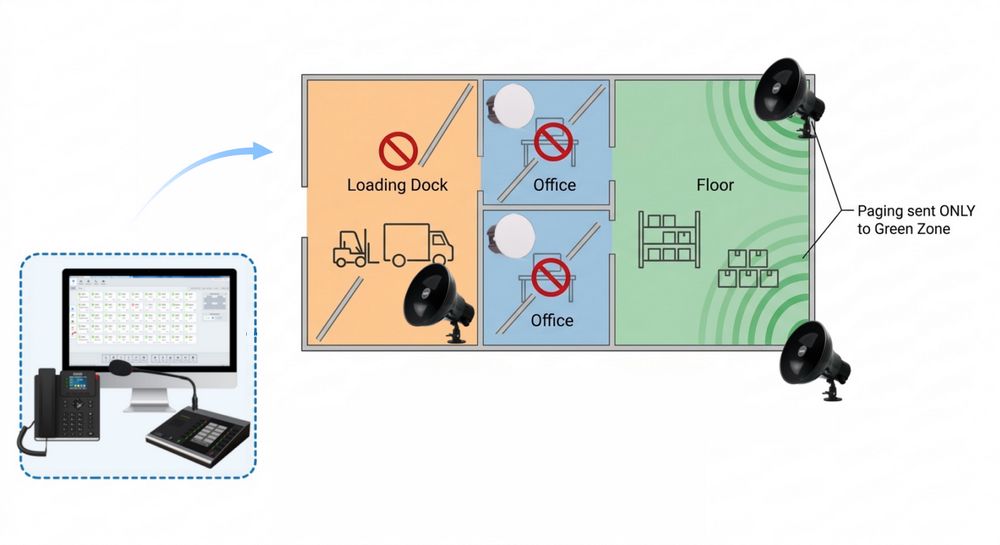
Multicast Zone Paging: Broadcast Instantly to the Right Areas
Multicast sends a single audio stream across the network, received simultaneously by every speaker in a configured group without added bandwidth, regardless of how many speakers are in the zone. Zones are defined entirely in software: warehouse floor, loading dock, offices, and break rooms, each as a separate multicast group.
Reconfiguring zones when the floor layout changes takes a few minutes in a browser. ZYCOO's IP Audio Center manages zones centrally, including scheduled announcements, priority overrides, and multi-site coordination from a single interface.
Choosing the Right IP Speaker for Each Warehouse Zone
The architecture above works the same regardless of which speaker you install. What changes by zone are the speaker form factor, the output level, and the environmental rating.
SIP Horn Speaker for Open Warehouse Floor
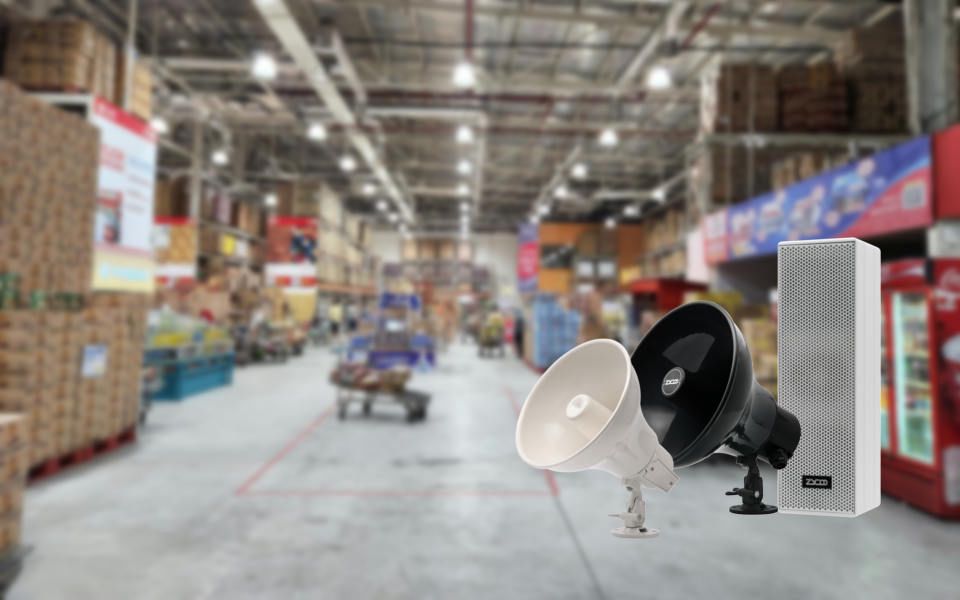
Horn speakers are purpose-built for open and high-noise environments with directional output projects across long distances in high-ceiling, noisy spaces. Look for a minimum of 105 dB SPL output for moderately noisy floors; louder operations need 110 dB or above. Wideband audio support also matters for reproducing speech frequencies clearly.
ZYCOO's SH30 Network Horn Speaker delivers 117 dB SPL from a 30W Class D amplifier, powered by PoE, with an IP65 enclosure that handles the dust and occasional wash-down of a working warehouse floor. It registers as a SIP endpoint, supports multicast zone paging, and uses the G.722 wideband codec for HD voice clarity. The SH10 is a smaller horn in the same lineup, suited for shorter-range coverage in less demanding zones.
Ceiling / Wall-Mount IP Speakers for Offices, Break Rooms, and Reception
Quieter internal zones need lower output, broader dispersion, better fidelity for music playback, and a form factor that suits indoor ceilings or walls. Ceiling and wall-mount IP speakers are the right tool here. With SIP-registered IP speakers, background music and voice paging share the same infrastructure — no secondary feed required. Incoming announcements automatically override music with priority, then release when finished.
ZYCOO's SC15 Network Ceiling Speaker supports SIP paging, HD voice, and streaming music via the IP Audio Center, running on PoE+ and mounting flush into a standard ceiling tile. The SC10 is a coaxial variant for more compact ceiling spaces. SW15 Network Cabinet Speaker with the same HD voice is also available for indoor wall-mounted installation in case the ceiling installation is inconvenient.
Weatherproof IP Speakers for Loading Docks & Outdoor Yards
Any speaker near dock doors or in an outdoor position needs to handle temperature swings, humidity, dust, and water. IP65 is the minimum rating worth specifying — dust-tight and protected against water jets from any direction.
The SH30 and SH10 both carry IP65 ratings, suitable for working in dock and outdoor yard positions as well as on the open floor. For outdoor staging areas and truck queues, ZYCOO's SL30 Network Column Speaker is an IP65-rated alternative with a slimmer profile suited to certain facility aesthetics.
Phased Migration from Analog to IP PA
The most common objection to upgrading a warehouse paging system isn't cost or technical complexity — it's the assumption that every existing speaker and cable has to go. That's rarely how IP paging migrations actually work.
Phase 1 — Start Where Analog Is Already Failing
The warehouse floor and loading dock are where analog coverage is typically most inadequate. Adding IP horn speakers to these zones, connected to the existing network switch, delivers immediate improvement without touching the rest of the infrastructure. The new speakers register to the SIP server and are operational quickly.
Phase 2 — Bridge Existing Analog Zones via Paging Gateway
For zones with working analog speakers like offices and break rooms, ZYCOO's Network Paging Gateway connects existing amplifier zones to the IP network, registering as a SIP endpoint and multicasting received audio to the connected legacy speakers. Those zones join the unified system without any hardware changes, responding to the same zone announcements and emergency broadcasts as the new IP speakers.
Phase 3 — Full IP Migration as Hardware Ages Out
With Phases 1 and 2 in place, the system runs in a stable hybrid state managed from ZYCOO's IP Audio Center. As amplifiers and zone controllers reach the end of life, they can be replaced with IP speakers one zone at a time, no forced cutover, no disruption to zones still functioning. The timeline can span months or years, depending on the budget and hardware condition.
Takeways: 5 Things to Look for in a Warehouse IP Paging System
SIP compliance and open-standard protocol. Speakers should register to any SIP 2.0 compliant server (RFC 3261), not a proprietary platform only.
Multicast zone support. Independent, software-defined zones are essential for multi-area warehouses. Look for at least 10 configurable multicast groups managed from a browser without physical rewiring.
SPL output matched to the environment. Don't buy one speaker model for the entire facility. Warehouse floor and dock zones need a minimum of 105 dB SPL. Offices and break rooms can be significantly lower.
PoE-powered (IEEE 802.3af or 802.3at). Eliminates separate power at each speaker location. Confirm the PoE class; horn speakers typically require PoE+.
Emergency priority override. Emergency broadcasts should interrupt all other audio streams. Integration with fire alarm panels or emergency notification platforms supports both safety performance and OSHA 29 CFR 1910.38 compliance documentation.
Conclusion
The real question for most warehouses isn't whether IP paging outperforms analog — it's how to get there without disrupting what's still working. A phased approach, starting where analog coverage is already failing, gives you a clear and manageable path forward.
Explore ZYCOO's SH30 Network Horn Speaker, SC15 Network Ceiling Speaker, and Network Paging Gateway — or contact our team for a warehouse-specific design consultation.
FAQs
Q1. Can I keep my existing analog speakers when upgrading to IP paging?
In most cases, yes. ZYCOO's Network Paging Gateway connects analog amplifier zones to the IP network, so existing passive speakers in working zones can remain in place while the new IP management layer takes over.
Q2. How many IP speakers do I need for a warehouse?
As a rough guide: one horn speaker per 500–800 sqm of open floor at 6–8 meter ceiling height, adjusted for very high ceilings or elevated noise. Office and break room zones typically use one ceiling speaker per 20–40 sqm. ZYCOO can assist with detailed coverage planning for larger or more complex floor plans.
Q3. Does a warehouse IP paging system require a dedicated server?
Not necessarily. ZYCOO's IP speakers register to an existing SIP-capable IP PBX. The IP Audio Center — available as software or on the IAS-L100 hardware appliance — adds zone management, scheduling, and mass notification on top of the base SIP infrastructure.