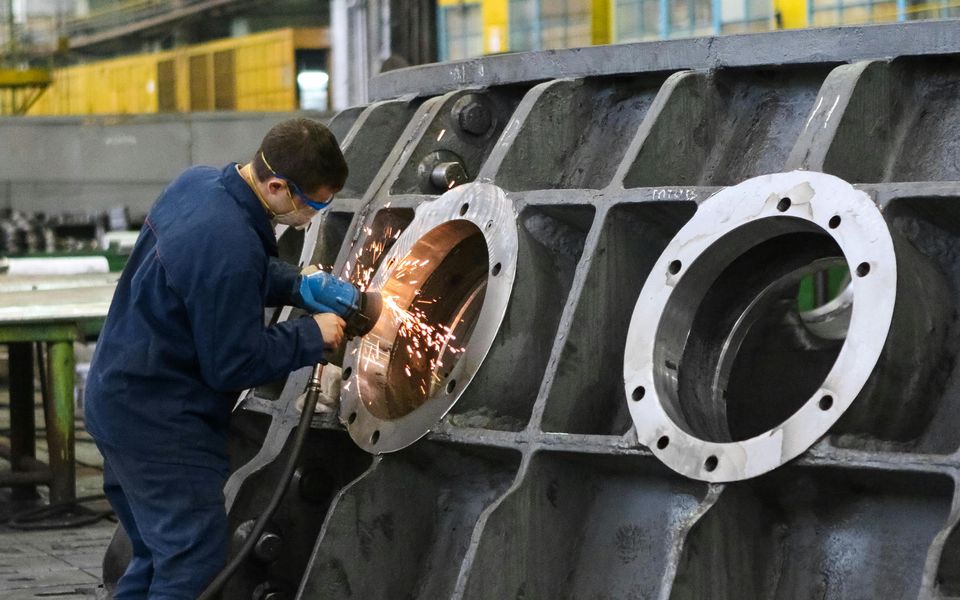
In industrial environments,noise is a constant. Production lines, motors, compressors, and automated machinery create a steady background noise that overlaps directly with PA broadcasts. Then, routine instructions are misheard, warnings are detected but not understood. Workers hear sound — but not words, thus causing missed evacuation signals, production errors from miscommunicated instructions, and in regulated facilities, direct exposure to OSHA and ISO 45001 compliance risk.
The issue is rarely the absence of equipment but the limitations of traditional PA design when applied to high-noise industrial settings. A system specified for an empty warehouse performs differently on a live factory floor at peak production. That gap is also where communication fails, and where under-specified systems become expensive to retrofit.
Noisy factories require more than louder speakers. They require IP communication systems designed around speech intelligibility, precise zone control, priority logic, and the physical realities of industrial sites.
This guide covers what an industrial PA system must deliver, how to apply proven acoustic design principles, and how to select the right devices for each zone — so the system works when it matters most.
What a High-Noise Industrial PA System Must Deliver
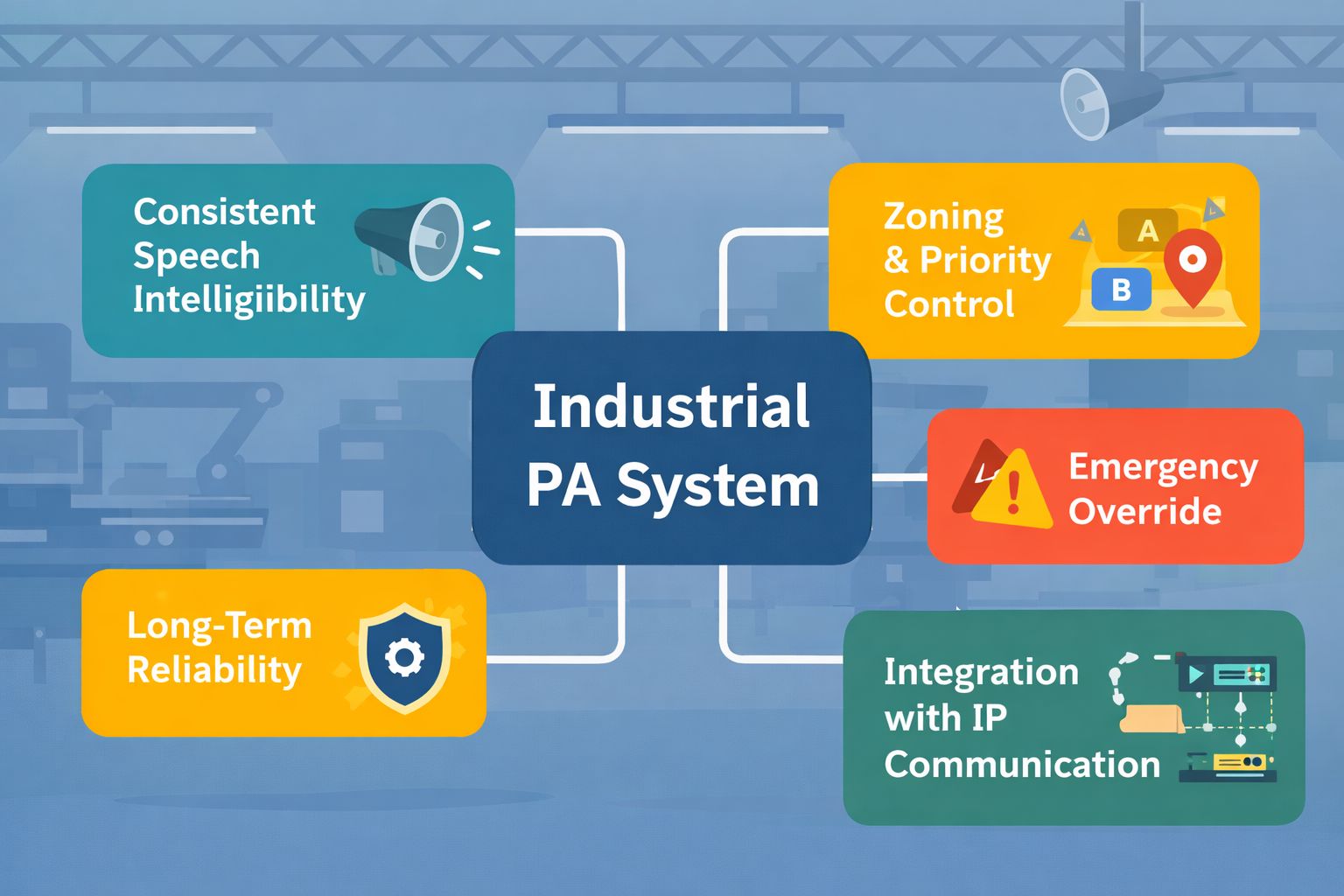
In a factory setting, a PA system is mission-critical infrastructure. To be effective, it must move beyond basic audio to meet these industrial benchmarks:
Consistent Speech Intelligibility: The primary requirement is not raw volume, but clarity. Systems must be optimized for voice frequencies (400 Hz–4 kHz) to ensure messages are distinguishable even when machinery is at full capacity.
Precise Zone Management: Factories are acoustically diverse. An effective system must support granular zoning, delivering targeted instructions to specific production lines without contributing to "noise pollution" in quiet control rooms.
Fail-Safe Priority Override: Safety never waits. The system must support multi-level priority logic, ensuring that emergency broadcasts automatically duck or mute routine background music or paging without manual intervention.
Two-Way Verification Ready: In high-risk zones, one-way broadcasting is insufficient. The infrastructure should support integration with IP Intercoms, allowing field operators to confirm receipt of instructions instantly.
Industrial-Grade Resilience: Factories are hostile to standard electronics. A reliable system must feature IP65/IP66 rated housing to repel conductive dust and moisture, alongside wide operating temperature tolerances (typically -40°C to +70°C) for non-climate-controlled environments. Equipment must be solid-state and vibration-resistant to ensure 24/7 operational continuity without frequent manual recalibration.
Acoustic Design Principles for Industrial Communication Systems
To transition from a working system to an optimized system, it's necessary to look beyond basic audio.
Acoustic Baseline: The +10 dB Rule
The first principle is to evaluate noise levels during normal production peak hours. For reliable intelligibility, the system's Sound Pressure Level (SPL) should be maintained at least 10dB above the ambient noise floor for normal operational standard, and +15dB for emergency broadcast zones.Do not design based on an empty plant.
Distributed vs. Centralized Coverage
Speaker placement should follow operational zones rather than architectural symmetry. when ambient noise exceeds 90 dB, or the coverage area per speaker exceeds a typical radius, distributed low-power placement outperforms centralized high-power devices that create hotspots of distorted sound and dead zones of silence.
Managing Sound Reflection and Focus
Directional speakers (Horns) typically 30–60° horizontal are effective for linear coverage in open factory halls to reduce noise spillover. ceiling- or wall-mounted speakers at 90–120° are superior for enclosed industrial spaces like workshops or equipment rooms, minimizing harsh reflections that muddy speech clarity.
Unified IP Architecture
System simplicity is a safety requirement. PA, intercom, and emergency triggers should operate on a unified IP platform. Fragmented legacy systems often reveal critical sync gaps during emergencies.
Device Selection: Matching Equipment Types to Industrial Needs
Selecting the right hardware is about balancing acoustic performance with environmental survival.
High-Efficiency Horns for High-Decibel Zones
In outdoor yards or expansive factory floors, IP-rated network horn speakers are the gold standard. Their high sensitivity allows them to cut through heavy machinery noise while maintaining low power consumption. Look for models with IP65 or higher ratings (ZYCOO's SH30 Horn Speaker) to ensure protection against industrial dust and moisture.
Specialized Intercoms for Critical Response
Where two-way verification is required — such as at loading docks or hazardous chemical zones— standard handsets fail. Industrial IP Intercoms with noise-canceling microphones and oversized "push-to-talk" buttons allow operators wearing heavy gloves to communicate clearly with the control room.
Professional Paging Consoles for Centralized Control
For project leads, the management interface is key. A SIP-based paging console allows for instant one-touch zoning, enabling a supervisor to speak only to "Line 4" without interrupting the rest of the facility.
At this stage, specific products can be evaluated. For example, ZYCOO offers industrial IP speakers, intercom devices, and microphone console designed to operate within a unified IP communication platform. These devices support zoning, priority control, and integration required in high-noise factory environments.
Beyond Audio: Integration with Industrial Safety Ecosystems
In a modern smart factory, communication is no longer a standalone silo; it is a critical subsystem of the safety ecosystem. A truly robust design leverages:
VMS Integration (Eyes-on-Paging): By linking audio zones with Video Management Systems, the control room gains instant visual confirmation of the area being paged.
Sensor-Driven Automation: Through I/O modules and IP sensors, the system can trigger logic-based alerting. For instance, a temperature spike or gas leak sensor can automatically activate high-priority voice warnings, ensuring zero-latency response.
How ZYCOO Empowers Industrial Communication
ZYCOO's PA and IP communication solutions for manufacturing are engineered to thrive in these demanding scenarios. Our platform provides a unified architecture that bridges the gap between raw hardware and intelligent safety logic.
By supporting standard SIP protocols to link with your existing safety and phone systems and featuring ruggedized endpoints such as our IP66-rated network horn speakers, ZYCOO enables integrators to deploy systems that are not only loud and clear but also smart enough to adapt to real-time industrial emergencies, helping reduce response latency and human error during critical industrial crises.
From Noise to Clear Industrial Communication
High-noise industrial environments expose the limitations of traditional PA systems. Clear factory communication requires more than louder speakers. It requires systems designed around intelligibility, control, and operational reality.
By defining what an industrial PA system must deliver, applying practical design principles, and selecting appropriate device types, factories can significantly improve safety, efficiency, and confidence in their communication infrastructure.
A properly designed PA and IP communication system is not just a technical upgrade. It is a foundation for reliable industrial operations.
If you are planning or upgrading a PA system for a noisy industrial environment, ZYCOO's team can support system design discussions, technical evaluation, and solution planning based on real factory requirements.