While most modern communication designs prioritize SIP trunks and IP PBX, FXO and FXS interfaces remain critical components in real-world tenders and hybrid deployments. These terms seem simple on paper, yet they often confuse when a company moves to IP but must retain legacy analog lines or devices.
Understanding the practical distinction between FXO and FXS is the key to avoiding unnecessary system complexity and over-engineering.
This article explains FXO vs. FXS from a practical and application-focused point of view. It shows when they are genuinely useful, when they are often overused, and how to make better design decisions.
What Are FXO & FXS?
To understand FXO and FXS, forget the complex telephony jargon for a second and think about a simple "Power and Service" relationship. They always work in pairs, much like a wall socket and a plug.
FXS (Foreign Exchange Subscriber) is the "Socket." It is the port that actually provides the service. It delivers the dial tone, the ringing voltage, and the electrical power required to make an analog phone work. In any deployment, the FXS port is the "provider" side. You plug your analog phones, fax machines, or legacy paging adapters directly into an FXS port.
FXO (Foreign Exchange Office) is the "Plug." It is the port that receives the service. It behaves exactly like a telephone set. It "consumes" the dial tone and tells the system when the line is off-hook. In a modern VoIP environment, you use an FXO port to connect your system to an external PSTN (analog) line provided by the local telecom company.
In short:
- FXS = Service OUT (Connects to your analog devices).
- FXO = Service IN (Connects to the outside phone lines).
FXO vs. FXS: Core Differences That Affect System Design
Once you move past the definitions, the real conversation shifts to Stability and Control. In a VoIP project, FXO and FXS behave very differently under field conditions.
FXO: The Unpredictable "Wild Card"
The biggest challenge with FXO ports is that they interface with the "outside world." Since the FXO ports are connecting to a carrier's infrastructure, you are at the mercy of variables you cannot control.
Signaling Mismatches: Every country (and sometimes every carrier) has different standards for dial tones and hang-up signals. If your FXO gateway isn't tuned to the local profile, you'll face "ghost calls" or lines that never disconnect.
The Echo Battle: Because analog lines carry both transmit and receive signals on the same pair of wires, impedance mismatches often cause echo. While ZYCOO gateways include advanced Echo Cancellation, the FXO side will always require more fine-tuning than a pure digital SIP trunk.
FXS: The Predictable "Internal Asset"
FXS ports are much more stable because they live entirely within your internal infrastructure. You own the cable, and you own the device.
Power & Distance (The Loop Limit): The main engineering concern with FXS is the physical distance. Since the FXS port must provide "Loop Current" to power the analog phone, long cable runs (e.g., to a remote gate or a deep warehouse corner) can lead to a voltage drop. If the voltage is too low, the phone might not ring, or the audio will be faint.
The "Legacy Lifeline": Despite the push for IP, FXS remains the go-to for harsh environments. Analog phones connected via FXS are often more resilient in dusty factories or high-humidity areas where expensive IP phones might fail within months.
To simplify your hardware selection, the following table summarizes the key functional differences between FXO and FXS ports from an engineering perspective:
Feature | FXO (Foreign Exchange Office) | FXS (Foreign Exchange Subscriber) |
|---|---|---|
Physical Role | The "Receiver" (Plug). Behaves like a telephone set. | The "Provider" (Socket). Behaves like a telephone company switch. |
Connects To | PSTN Lines (from the carrier) or PBX extension ports. | Analog Devices (phones, faxes, paging, intercoms). |
Core Function | Detects ringing and seizes the line (off-hook). | Provides Dial Tone, Power, and Ringing Voltage. |
Power Logic | Consumes Power. Relies on the line current from the source. | Supplies Power. Provides the "Loop Current" to the device. |
Primary Risk | External Line Noise and signaling/hang-up detection issues. | Voltage Drop over long cable runs (Physical Distance). |
Common Use Case | Bringing local analog phone lines into a VoIP system. | Connecting legacy analog hardware to a VoIP system. |
How FXO and FXS Are Used in Modern VoIP Gateways
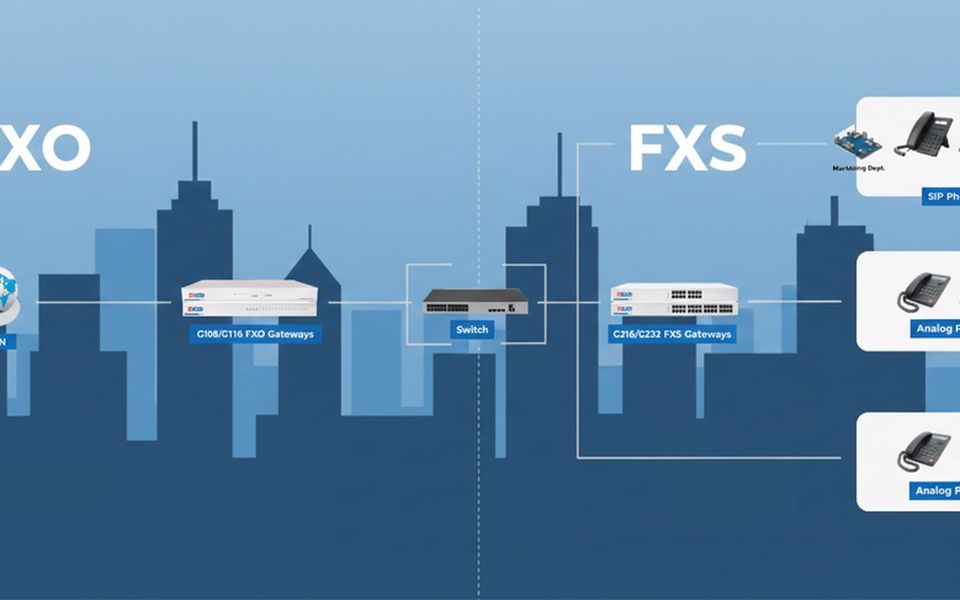
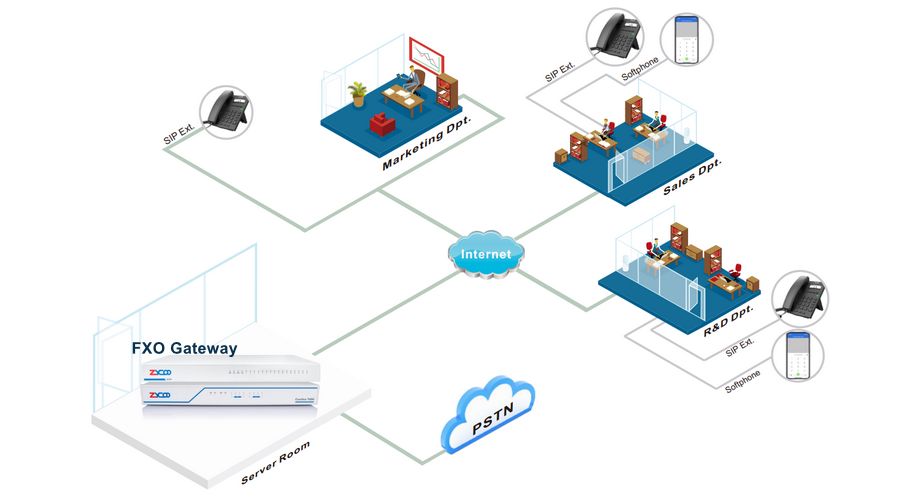
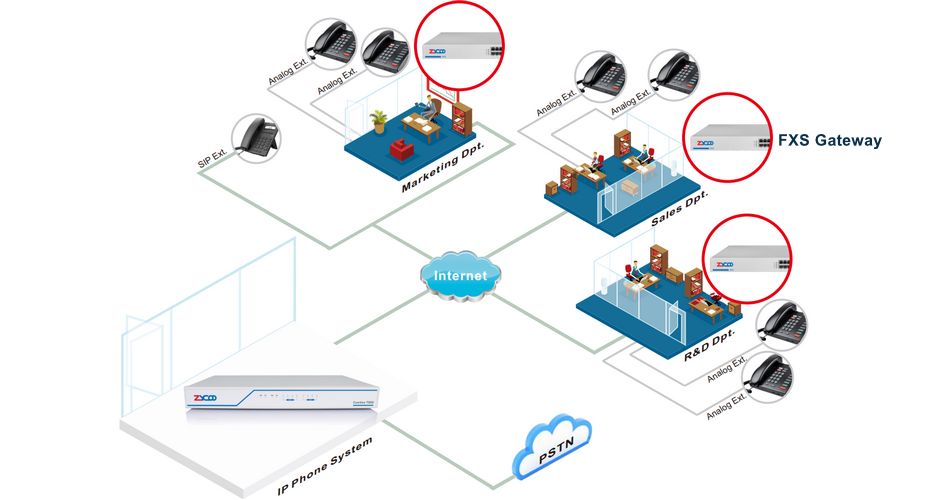
In modern IP architectures, these ports are typically housed in dedicated VoIP Gateways—specifically FXO Gateways for PSTN integration and FXS Gateways for analog device connectivity—or as modular expansion cards within a hybrid IP PBX.
An FXO Gateway acts as the PSTN-to-SIP bridge.
It digitizes incoming analog lines, allowing your IP phones, softphones, and mobile clients to place and receive calls through the traditional telephone network. It is the "On-Ramp" for analog service into your digital core.
An FXS Gateway acts as the Device-to-SIP bridge.
It translates analog signaling from legacy phones, fax machines, or paging amplifiers into SIP-compliant packets that an IP PBX can process. It is the "Adapter" that keeps your reliable legacy hardware functional in a VoIP world.
Essentially, the FXO Gateway brings the Carrier to the network, while the FXS Gateway brings the Endpoint to the network. ZYCOO's IP PBX systems and gateways support this modularity, making hybrid deployments easier. This allows existing analog infrastructure to remain usable while gradually moving toward full IP communication.
Strategic Deployment: When to Use Analog vs. SIP
Both FXO and FXS still have their place in 2026, but they are often specified without clear justification. Before adding an analog port, use this decision framework
The Case for FXO (PSTN Integration)
When it makes sense: Use FXO when you need a "hard" backup for your SIP trunking (e.g., in mission-critical facilities where internet stability is sub-par) or when local regulations mandate analog for emergency services.
When it is overused: Avoid FXO if you have a stable SIP trunk and secondary internet redundancy. Adding FXO "just in case" often introduces ground-loop noise and signaling overhead that creates more helpdesk tickets than it saves.
The Case for FXS (Analog Endpoint Connectivity)
When it makes sense: FXS is your best friend for Specialized Endpoints—analog door phones, heavy-duty industrial intercoms, or paging amplifiers that don't have an IP network port. It’s also the go-to for Harsh Environments where delicate IP electronics might fail.
When it is overused: Using FXS to power standard office phones. Unless there is a regulatory compliance reason, standardizing on IP phones provides superior call quality, feature parity, and remote management that analog simply cannot touch.
Common FXO/FXS Deployment Mistakes in Real Projects
While standard deployment is straightforward, real-world variables often lead to common pitfalls that can delay project sign-off.
Miscounting Port Requirements
FXS ports are often overestimated, FXO ports often underestimated. The safest approach is to list every analog line and device and confirm whether it is truly needed.
Ignoring Line Quality
Not all PSTN lines are clean. Noise, grounding issues, and signal instability can affect FXO performance. Testing real lines before deployment avoids surprises.
Overlooking Echo Issues
Echo usually comes from mismatches between analog and IP environments. Gateways provide echo cancellation, but real-world testing is still necessary.
Treating FXO as Plug-and-Play
Dial tones and signaling differ by country and carrier. Regional settings must match local standards, or call detection will fail.
ZYCOO gateways offer adjustable gain, noise control, echo cancellation, and regional profiles, which help adapt to different environments, but correct setup is still essential.
FXO / FXS vs SIP Trunk: A Migration Perspective
Aspect | FXO/FXS | SIP Trunk |
|---|---|---|
Cost | Fixed monthly fees, hardware required | Lower per-channel cost, flexible |
Stability | Independent of internet quality | Depends on network and QoS |
Scalability | Slow to expand, requires carrier work | Channels added instantly |
Flexibility | Simple but limited routing options | Advanced routing and failover |
Future-proof | Declining technology | Long-term industry direction |
Summary: FXO and FXS are useful during transition. SIP trunking is usually the end goal. A common approach is to use SIP trunks for main traffic and keep minimal FXO lines only for backup or compliance, while FXS is used only where analog devices are still justified.
Applying FXO and FXS in Real Projects with ZYCOO
ZYCOO provides IP PBX systems and gateways that support both FXO and FXS integration, allowing flexible hybrid designs. Our product range includes:
- Analog VoIP gateways with 2–32 FXO/FXS ports
- SIP gateways for pure IP trunking
- IP PBX systems with native SIP and analog support
- Paging and intercom adapters for legacy systems
Whether you are planning a gradual migration or designing a new VoIP system, understanding when to use FXO and FXS can simplify your architecture and reduce long-term cost.
If you are evaluating options or refining a system design, ZYCOO is always open to discussing real-world requirements and helping you choose a practical, balanced approach.