Your IP PBX runs well. Your team is on SIP phones, call routing is clean, but you still have active PSTN line contracts you can't drop. Maybe the carrier has early-termination penalties. Maybe compliance mandates a hard analog fallback for emergency routing. Either way, you need both worlds to work together. That's exactly what an FXO gateway is for.
An FXO gateway (short for Foreign Exchange Office gateway) is a hardware device that connects existing analog PSTN telephone lines to a modern VoIP or IP PBX network, converting analog voice signals into SIP packets so both systems can communicate seamlessly. It doesn't replace your carrier lines. It integrates them into your IP infrastructure.
This guide covers how the signal conversion works, the scenarios where deploying an FXO gateway is the right call, why dedicated vs. combo architecture matters at scale, and which features determine performance in the field. Let's dive in.
How an FXO Gateway Works
FXO stands for Foreign Exchange Office, the interface that receives analog line service from the carrier. In a standalone FXO gateway, every port on the device is an FXO port, meaning the gateway itself acts as the "office" endpoint that interfaces directly with the PSTN. For a deeper look at how FXO compares to FXS at the port level, our FXO vs. FXS guide covers that thoroughly.
The Inbound Call Path: PSTN to Your IP Network
When a call arrives from the PSTN, the carrier sends approximately 90V AC of ring voltage down the analog line. The FXO port detects this voltage change and registers an incoming call event, then goes off-hook to complete the loop closure, signals to the carrier that the call is answered, just like picking up a handset.
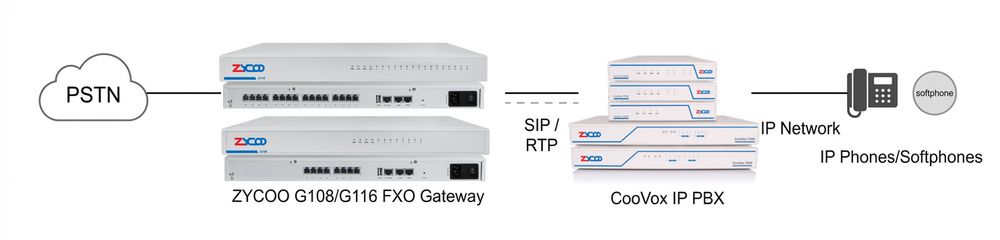
The gateway's DSP then samples the incoming analog audio and encodes it into digital packets. G.711 is standard for LAN-connected deployments and G.729 is the right choice for bandwidth-constrained WAN links. The encoded audio is wrapped into RTP streams, and a SIP INVITE goes to the IP PBX (ZYCOO's CooVox system), which routes the call to the destination IP phone or softphone.
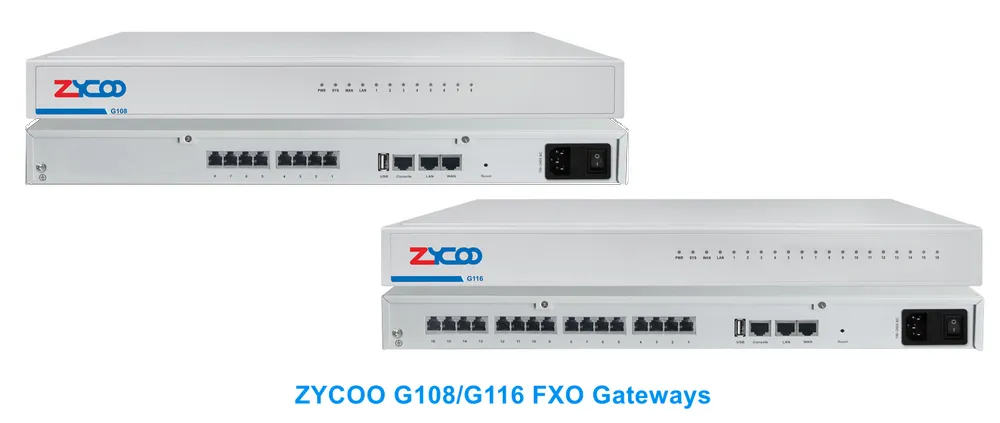
Each RJ-11 port on the gateway corresponds to one PSTN line and one concurrent call. Port count equals concurrent call capacity. The ZYCOO G108 FXO gateway has 8 FXO ports; the G116 has 16.
The Outbound Call Path: IP Network to PSTN
An IP phone dials out, and the SIP session reaches the IP PBX, which evaluates its dial plan and routes the call to the FXO gateway trunk. The gateway seizes an available port, goes off-hook on the PSTN line, and dials the destination as DTMF tones to the carrier. The DAC converts digital RTP audio back into analog for transmission over the line.
One configuration detail worth getting right: the DTMF transmission mode (RFC2833, SIP Info, or in-band) must match the IP PBX configuration. A mismatch is a common source of failed transfers or one-way audio. ZYCOO's G-Series supports all three modes, so this doesn't require any hardware compromise.
When Do You Need an FXO Gateway? Five Real-World Scenarios
Mission-critical PSTN Failover
Hospitals, emergency dispatch centers, and public safety facilities can't let voice communication go down with the internet. An FXO gateway provides infrastructure-independent PSTN fallback—when the SIP trunk fails, calls re-route through the analog lines automatically. A secondary SIP trunk still depends on internet connectivity; the PSTN line does not.
Bridging the VoIP Migration Window
Most enterprises can't cut over to full VoIP in a single event. Active carrier contracts with early-termination clauses and staggered multi-site rollouts create a transition window, during which analog lines must coexist with the new IP infrastructure. An FXO gateway handles the coexistence cleanly.
Multi-site Branch Offices with Local PSTN Lines.
Branch offices in regions with incosistent SIP trunk quality often retain local analog lines for reliability. Connecting those lines to a central CooVox IP PBX through a gateway at each branch keeps local calls local, cutting the cost and latency of routing outbound calls through headquarters.
Regulatory and Emergency Service Compliance
Certain jurisdictions mandate that emergency calls remain routable over PSTN regardless of internet status. One or two dedicated gateway satisfy this requirement without maintaining a full legacy PBX.
Legacy PBX Co-existence During Phased Replacement
Organizations running a TDM or hybrid PBX alongside a new IP PBX often need to share PSTN trunks across both systems during the transition. A gateway at the demarcation point distributes incoming lines across both systems simultaneously, with no duplicate carrier circuits.
When an FXO gateway isn't the Right Answer
If your organization already has stable, redundant SIP trunking with secondary internet failover, adding FXO introduces complexity the environment doesn't need, ground-loop noise, regional signaling maintenance, and additional hardware to monitor. If SIP trunking is covering your needs reliably, stay with it.
Dedicated FXO Gateway vs. Combo FXO/FXS Device: Why Architecture Matters
Most gateway vendors ship combo devices, a single chassis with a mix of FXO and FXS ports. For small offices with modest, stable requirements, that's workable. The problem appears at an enterprise scale or in any deployment where trunk line capacity and analog endpoint capacity grow at different rates, which are most of them.
ZYCOO's G-Series gateways use a dedicated architecture. The G108 and G116 are pure FXO gateways; the G216 and G232 are pure FXS gateways. The two tiers are separate, independently scalable hardware. Here's why that matters in practice.
Independent capacity scaling. In a combo device, adding PSTN lines means buying more FXS ports too, even if you don't need additional analog endpoint capacity. With dedicated hardware, each tier scales independently. A hospital that needs 16 PSTN failover lines but only 8 analog endpoints deploys a G116 and a portion of a G216 — right-sized for the actual requirement, not constrained by a fixed port ratio.
Purpose-built signal processing. A dedicated FXO gateway's DSP is tuned specifically for analog line reception. Echo cancellation coefficients, disconnect supervision algorithms, and line detection thresholds are configured for PSTN-side characteristics. A combo device splits its DSP budget across two different interface types, which means less refined performance on each.
Cleaner fault isolation. When a PSTN line issue occurs on a dedicated FXO gateway, it stays isolated to that device. On a combo chassis, a carrier-side problem can surface as FXS port behavior or shared-resource contention, making diagnosis slower and harder.
# | Dedicated FXO Gateway | Combo FXO/FXS Device |
|---|---|---|
Capacity scaling | Independent per interface type | FXO & FXS grow together |
DSP optimization | Purpose-built doe PSTN reception | Split across two interface types |
Fault isolation | PSTN layer fully separate | PSTN and endpoint faults share chassis |
Best suited for | Enterprise, multi-site, regulated verticals | Small offices with stable mixed demand |
Key Features to Evaluate When Choosing an FXO Gateway
Whether you're looking at a dedicated or combo device, the following are key factors in determining real-world performance.
Port Count and Concurrent Call Capacity
One FXO port handles one PSTN line and one concurrent call. Size based on peak concurrent call volume, not total extension count. A practical starting point: one port per 8 to 10 extensions, plus 2 to 4 additional ports of failover headroom. ZYCOO's G108 FXO gateway suits SME deployments and branch offices; the G116 is appropriate for enterprise primary trunks or high-volume inbound sites.
SIP Protocol Compatibility
Standard SIP compliance (RFC 3261) is the baseline. Both ZYCOO's G108 and G116 FXO gateways implement it across UDP, TCP, and TLS transport, registering cleanly to any mainstream IP PBX, such as ZYCOO CooVox, Asterisk, FreePBX, 3CX, or Cisco CUCM, without proprietary handshakes.
Regional PSTN Signaling Profiles
This is where most FXO deployments go wrong. Every country, and sometimes every carrier, uses different standards for disconnect supervision, dial tone cadence, and loop current thresholds. When the gateway's profile doesn't match the carrier's disconnect supervision method, it misses the hangup signal: the PSTN line stays open, the port is blocked, and no one can use it until someone manually intervenes. Engineers call this a ghost call. It's entirely preventable—but only if you verify the regional profile against your actual carrier lines before go-live.
Echo Cancellation
Analog PSTN lines transmit and receive audio on the same copper pair. Impedance mismatches between the carrie and the FXO port create echo—a delayed copy of the speaker's own voice heard by the listener. G.168-compliant echo cancellation with configurable tail length addresses this. The ability to cancellation parameters to actual line conditions at each site makes a real, audible difference in call quality.
Security: TLS Signaling Encryption
VoIP toll fraud is an active operational risk on any SIP-based infrastructure. TLS encrypts the SIP signaling channel against interception and spoofing. Both the G108 and G116 FXO gateways support TLS alongside UDP and TCP transport. For healthcare, government, or financial deployments, TLS is a mandatory configuration. Pair it with SRTP media encryption at the IP PBX level for full end-to-end voice security.
Management, Monitoring, and Auto-Discovery
Web GUI, SNMP, call detail records, remote diagnostics, CLI and API access are the management baseline for any enterprise gateway. For CooVox deployments specifically, the G-Series supports auto-discovery, registering the gateway automatically on the same network—no manual trunk provisioning needed.
Deployment Considerations: What the Spec Sheet Won't Tell You
Test with actual carrier lines before go-live. PSTN characteristics vary across carriers, regions, and even within the same provider's CO locations. Validate the regional signaling profile against real lines from your deployment carrier. Run inbound, outbound, transfer, and hold scenarios before cutover. Ghost calls found post-deployment are far more disruptive to fix.
Isolate gateway traffic on a voice VLAN with QoS. Mark FXO gateway RTP streams with DSCP EF (46) and enforce that marking at the switch. PSTN calls already have higher inherent latency than SIP-to-SIP calls; adding jitter from shared data traffic results in MOS degradation that users notice immediately.
Secure the SIP path at branch locations. When a branch FXO gateway registers to a central IP PBX system at headquarters, that SIP trunk needs to traverse a site-to-site VPN or MPLS link. Unprotected SIP over the public internet creates both call quality and security exposure.
Match the codec to your WAN link. G.711 delivers the best audio quality on FXO trunks but consumes 64 Kbps per call. On constrained WAN links, G.729 at 8 Kbps is the standard alternative. The G108 and G116 support G.722, G.711 (µ-law and A-law), G.726, G.729, GSM, and SPEEX — enough flexibility to match the codec to actual link conditions at each site.
Conclusion
While modern VoIP has revolutionized business communication, the reality of global infrastructure is that analog connectivity remains a bedrock of reliability for many organizations. Whether you are navigating regulatory compliance, building a bulletproof failover strategy, or bridging the gap during a phased migration, your choice of gateway architecture dictates your system’s stability. By prioritizing dedicated processing and robust signaling validation, you ensure that your PSTN lines remain an asset, not a bottleneck.
Explore the [ZYCOO G108 and G116 FXO Gateways] for detailed specifications, or reach out to our engineering team to discuss how to optimize your specific voice architecture.
FAQs
Q1. What's the difference between an FXO gateway and an FXS gateway?
An FXO gateway connects PSTN trunk lines to your VoIP network. It's the carrier-side device. An FXS gateway connects analog endpoints (phones, fax machines, and intercoms) to your VoIP network. It's the device-side gateway. ZYCOO's G108/G116 are FXO gateways; the G216/G232 are FXS gateways.
Q2. Can an FXO gateway work with any IP PBX?
Yes, as long as the IP PBX supports standard SIP, which all mainstream platforms do. ZYCOO's G-Series has been validated with CooVox, Asterisk, FreePBX, 3CX, and Cisco CUCM. For CooVox deployments, auto-discovery handles trunk registration automatically.
Q3. How many FXO ports do I need?
One port per PSTN line, one line per concurrent call. Add 20 to 25 percent growth headroom, then 2 to 4 additional ports for failover. The G108 (8 ports) covers most SME and branch deployments; the G116 (16 ports) is sized for enterprise primary trunks.
Q4. Is an FXO gateway still relevant with SIP trunking available?
For organizations with stable, redundant SIP trunking and no regulatory constraints, often no. For mission-critical failover, regulated verticals, regions with poor SIP trunk quality, or multi-site deployments with local PSTN contracts, yes.
Q5. Do ZYCOO FXO gateways support encryption?
Both G108 and G116 support TLS for SIP signaling encryption. Pair with SRTP at the CooVox IP PBX level for end-to-end voice security.