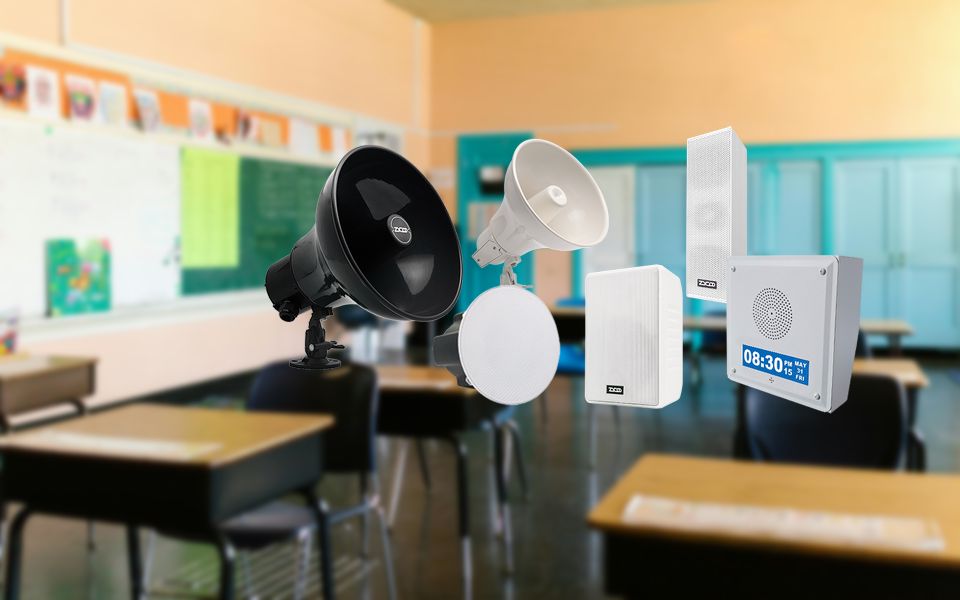
Most schools have intercom systems, but not all are designed to support today's communication and campus safety requirements. During routine operations and emergencies alike, schools depend on clear, reliable communication between classrooms, administrative offices, security personnel, and campus entrances.
An IP-based school intercom system enables two-way communication across campus, helping teachers, administrators, and security staff coordinate daily operations and respond more effectively to unexpected situations. Unlike traditional analog intercoms, modern IP intercom systems can provide centralized management, flexible deployment, and seamless integration with other campus communication and security systems.
This guide explains what a school intercom system is, how it works, its core functions, and how it fits into a modern campus communication infrastructure.
What Is a School Intercom System?
A school intercom system is a communication platform that enables voice communication between classrooms, administrative offices, security personnel, campus entrances, and other key locations. Unlike a public address (PA) system, which primarily broadcasts one-way announcements, a school intercom system supports two-way communication, allowing teachers, office staff, and security personnel to exchange information quickly and efficiently.
Modern IP-based school intercom systems use a school's existing IP network to connect intercom endpoints, management software, and communication devices into a centralized platform. Beyond supporting routine classroom and administrative communication, they also help schools coordinate visitor management, security operations, and emergency response through reliable, real-time voice communication.
While school intercom and PA systems serve different communication purposes, they often work together as part of a unified campus communication infrastructure. Understanding these differences helps schools choose the right solution for their operational and safety requirements.
How Does a School Intercom System Work?
A modern IP-based school intercom system typically consists of three core components: a centralized management platform, an IP network infrastructure, and distributed intercom endpoints. Together, these components enable reliable two-way communication across classrooms, offices, and campus entrances while providing administrators with centralized control over the entire system.
Centralized Management Platform
Every school intercom system requires a central point for monitoring, managing, and coordinating communication. Typically located in an administrative office, security room, or campus operations center, the management platform allows authorized personnel to initiate calls, communicate with individual classrooms or entrances, monitor device status, and manage communication zones from a single interface.
For example, ZYCOO's IP Audio Center, together with the IP Audio Dispatch Console, provides centralized management for campus-wide communication. Operators can quickly locate intercom endpoints, initiate two-way conversations, and monitor the operational status of connected devices through a unified management interface.
IP Network Infrastructure
Modern school intercom systems use the campus IP network to connect the centralized management platform with distributed intercom devices. Unlike traditional analog systems that rely on dedicated wiring and fixed communication paths, IP-based systems provide greater flexibility for expansion, zoning, and centralized management.
Voice communication must remain clear and predictable even when other campus services are active. Power over Ethernet (PoE) can simplify installation by delivering both power and network connectivity through a single cable, while SIP enables interoperability with IP phones and other communication systems. A reliable network foundation ensures that two-way communication remains available whenever staff needs it most.
Intercom Endpoints Across Campus
Intercom endpoints are the devices that enable communication throughout the campus. Depending on the application, they may be installed in classrooms, corridors, administrative offices, building entrances, reception areas, or other locations where two-way communication is required.
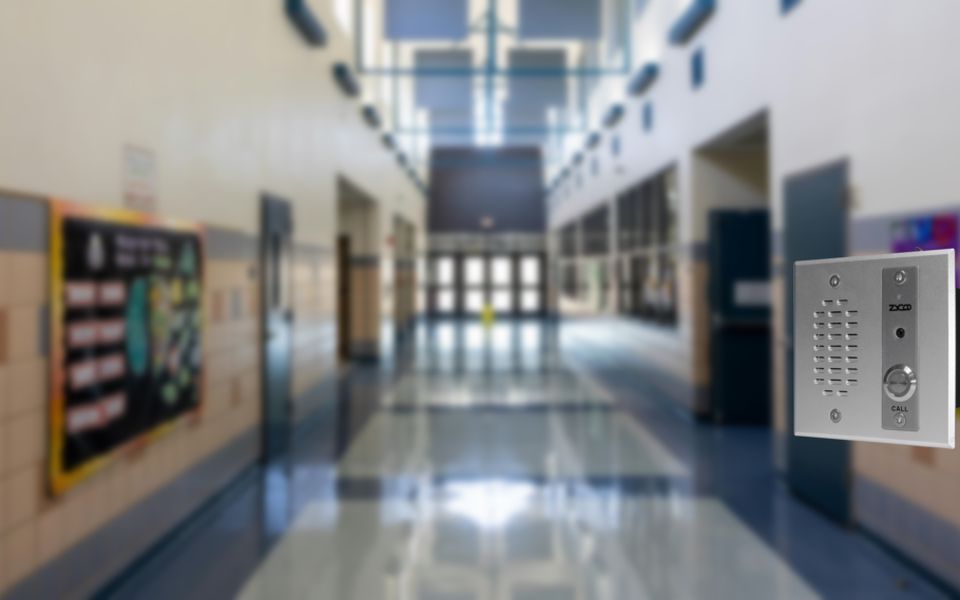
For example, the ZYCOO VI Series IP intercoms can be deployed at required locations to provide reliable two-way voice communication. During daily operations, teachers can quickly contact the administration office for assistance, while office staff can communicate directly with individual classrooms or visitors without leaving their workstations. During an emergency, administrators can initiate a call to a specific classroom or campus area to verify local conditions, while teachers and staff can immediately report real-time information back to the control center. This two-way communication enables decision-makers to receive live updates from across the campus, helping coordinate a faster and more informed response than one-way announcements alone.
Core Functions of a Modern School Intercom System
Classroom and Administrative Communication
In most schools, intercom systems are used far more often for routine coordination than for emergencies. Morning announcements, class transitions, schedule changes, and staff communication all rely on the same infrastructure. Because of this, the system becomes part of the school's daily rhythm rather than a tool that only appears during incidents.
Administrators use the intercom to reach specific buildings or groups of classrooms without interrupting the entire campus. Teachers can contact the office when support is needed, whether for a student issue, a medical concern, or simple coordination. The same communication path also supports teacher assistance requests, visitor inquiries, and administrative coordination without requiring staff to leave their locations.
This everyday use is important. It exposes audio issues early. It shows whether zoning matches how the campus is actually used. And it ensures staff are comfortable with the system long before it needs to support time-critical communication.
Emergency Communication
When conditions change, the same intercom system shifts from routine messaging to coordinated response. During emergencies, administrators can communicate directly with affected classrooms or campus zones while receiving real-time updates from teachers and staff. Two-way communication helps decision-makers understand changing conditions instead of relying solely on one-way announcements. This communication and response loop helps reduce confusion and unnecessary escalation.
In more advanced setups, intercom systems also interact with other campus systems during emergencies. Voice instructions can align with access control actions or safety procedures, helping schools respond in a coordinated way.
Integrating School Intercoms with Other Campus Systems
Modern school intercom systems rarely operate as standalone communication tools. Instead, they are often integrated with other campus communication and security systems to streamline daily operations, improve information sharing, and support coordinated emergency response. By connecting these systems through a unified IP infrastructure, schools can reduce operational complexity while enabling faster decision-making across the campus.
IP Paging and PA Systems
School intercom systems and school paging or PA systems serve different purposes, but they work best when deployed together. An intercom system enables two-way communication between teachers, administrative staff, security personnel, and visitors, while a paging or PA system delivers one-way announcements to classrooms, corridors, outdoor areas, or the entire campus.
By integrating the two, schools can seamlessly transition from individual conversations to campus-wide notifications. For example, an administrator can communicate directly with a teacher through the intercom system before broadcasting important instructions through the paging or PA system when broader communication is required.
SIP PBX and Unified Communications
Many schools already use a SIP PBX to support internal extension calling. Integrating the school intercom system with the campus telephony platform allows classrooms, reception desks, security offices, and administrative staff to communicate using a unified extension network instead of operating separate communication systems.
This integration simplifies daily collaboration while enabling staff to reach intercom devices directly from IP phones, desktop clients, or mobile applications, improving communication efficiency across the campus.
Access Control and Video Surveillance
School intercom systems are commonly integrated with access control and video surveillance systems to strengthen visitor management and campus security. At building entrances, office staff can communicate with visitors through the intercom while simultaneously viewing live video before granting or denying access.
During security incidents, combining voice communication with real-time video helps administrators quickly assess the situation and coordinate appropriate responses without relying on separate systems.
Fire Alarm and Emergency Systems
During emergencies, voice communication plays an important role alongside alarm systems. While fire alarms or emergency notification systems alert occupants that an incident has occurred, the school intercom system enables administrators to deliver clear instructions, communicate with specific locations, and coordinate response efforts as situations evolve.
Integrating these systems helps schools deliver more organized emergency communication, ensuring staff receive both immediate alerts and ongoing operational guidance throughout an incident.
How to Choose a School IP Intercom System
Every school has different communication requirements depending on its size, building layout, and daily operations. Choosing the right school intercom system means weighing these factors against your budget and long-term plans — not just comparing feature lists. The considerations below reflect what facilities managers and integrators typically evaluate before selecting or deploying a school IP intercom system.
Campus Size and Scalability
Start by determining whether the system needs to serve a single building, multiple buildings, or an entire campus. Larger campuses typically require multiple communication zones and centralized management to keep daily operations manageable. Because school communication needs evolve as buildings expand, student populations grow, or new safety policies are introduced, the selected system should also scale without requiring a redesign: additional devices, zones, and integrated applications should be addable to the existing architecture rather than needing a separate, parallel system.
Coverage, Endpoint Types, and Placement
Identify every location where two-way communication is needed — classrooms, administrative offices, corridors, entrances, parking areas, playgrounds, and sports facilities — and match the endpoint type to what each location requires.
IP audio intercoms are typically sufficient for classrooms and internal communication, while IP video intercoms add visual verification at campus entrances before staff grant access. Outdoor installations should use weather-resistant intercoms with an IP65-rated enclosure, such as the ZYCOO VI Series, to hold up in exposed conditions. Endpoint placement should follow daily communication workflows rather than simply mirroring the building layout, so teachers, administrators, security personnel, and visitors can all reach the system efficiently from where they actually work.
Network Infrastructure
Since an IP-based school intercom system runs over the campus network, plan for sufficient network coverage, PoE switch capacity, and reliable connectivity to support stable two-way voice communication across every endpoint.
System Integration
Decide whether the intercom system needs to integrate with other campus technologies — PA systems, SIP PBXs, access control, or video surveillance — to build a more unified communication and campus safety solution rather than a set of standalone tools.
Budget and Vendor Selection
Intercom system cost varies significantly based on endpoint count, video vs. audio-only devices, and whether the deployment integrates with existing PA, access control, or PBX infrastructure — weigh hardware cost alongside installation complexity and the ongoing management effort a centralized platform can reduce.
When evaluating vendors or integrators, prioritize those with direct experience in K-12 or campus deployments: bell schedule synchronization, classroom-specific zoning, and integration with existing safety systems all benefit from installer familiarity with school environments. Confirm the proposed system can meet applicable local building and life-safety code requirements for your state before finalizing a design.
Closing Thoughts
A school intercom system is rarely the most visible part of a campus safety strategy. But it is often the most used. When communication works quietly in the background, it supports both learning and safety without drawing attention to itself.
Whether deploying a new communication system or improving an existing campus infrastructure, schools should consider how intercom, paging, and public address systems work together rather than as isolated technologies. ZYCOO's IP communication solutions help education facilities build scalable communication environments that support daily collaboration, visitor management, and campus safety.