When an emergency happens, people need clear and fast delivered instructions, and they need to trust what they hear. That's where an emergency PA system becomes different from a normal public address system. It's not just about playing notifications. It's about taking control of communication when everything else is uncertain.
In schools, factories, office buildings, and transport hubs, a PA system in emergency situations often becomes the main channel that guides evacuation, keeps panic under control, and connects safety procedures with real actions on-site. If it fails, confusion spreads quickly. If it works, it buys time and saves lives.
In this blog, we will learn the importance of the emergency PA system and how a PA system helps in emergencies.
What Is an Emergency PA System and Why It Is Necessary
What Is an Emergency PA System?
Simply put, an emergency PA system is a life-safety infrastructure designed to secure the highest communication priority. It serves as the definitive "voice of authority" during critical events, ensuring that crucial instructions reach every corner of a facility without interference from daily operations.
Unlike a standard PA that mainly serves daily announcements, an emergency PA system is built around control, reliability, and predictability. It must work instantly, even when power is unstable, networks are overloaded, and multiple people are reacting simultaneously.
In practice, it connects audio broadcasting with safety processes. Fire alarms, security systems, and manual emergency panels all can trigger announcements. Pre-recorded messages guide evacuation. Live voice announcements adapt to what is actually happening on site. All of those happen within one communication framework.
Today, in many projects, emergency PA is no longer treated as a separate "audio feature." It's part of the unified communication infrastructure.
How an Emergency PA System Differs from Normal PA, Paging, and Background Music
A normal PA system focuses on convenience. Paging systems focus on person-to-person or area-to-area announcements. Background music systems focus on ambience. None of them are built to take control during chaos.
The emergency PA system introduces priority levels, authority, and system behavior. Emergency messages override everything else; only specific devices or operators can trigger emergency broadcasting, and the system reacts automatically based on predefined rules.
For example, in a typical office setup, background music might be playing while paging is used occasionally. In an emergency, both should stop instantly. The emergency message goes out without delay and without human coordination across different systems.
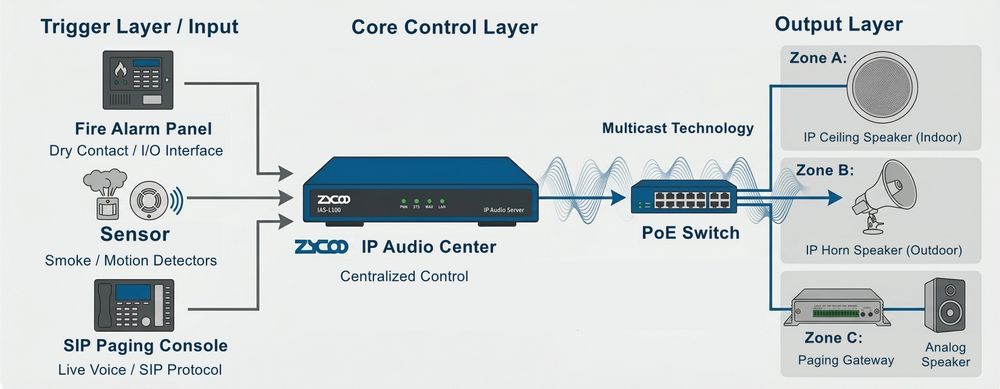
This is where IP-based emergency PA systems demonstrate a clear technological edge. By leveraging IP Multicast technology, these systems enable high-fidelity, low-latency audio distribution across sprawling network infrastructures. Unlike legacy systems that struggle with synchronization, an IP-based architecture ensures that evacuation instructions reach thousands of endpoints simultaneously and synchronously. This unified approach, as seen in ZYCOO’s IP audio platforms, allows emergency broadcasting, intercom, and VoIP to operate within the same low-latency communication framework, eliminating the risks of system fragmentation.
Risks of Not Having a Dedicated Emergency PA System
Many sites still rely on ordinary PA systems and hope they will work well enough in emergencies. However, in real emergencies, problems arise. Background audio doesn't stop. Operators don't know who should speak. Messages are repeated or contradicted. Some zones hear nothing at all. People hesitate because the instructions are unclear.
Another risk is accountability. After an incident, questions always come:
- Was the message sent?
- When was it triggered?
- Who activated it?
- Which areas received it?
Without a system that records and structures emergency communication, these answers are often missing. That creates operational risk and legal exposure, not just technical problems.
What a PA System Actually Solves in Emergencies
Identifying these risks is only the first step. A well-designed system transforms these vulnerabilities into a structured, automated response. Here is how a dedicated PA system solves specific challenges in real-world emergencies:
Fire Emergencies: From Sensor Trigger to Full Evacuation Guidance
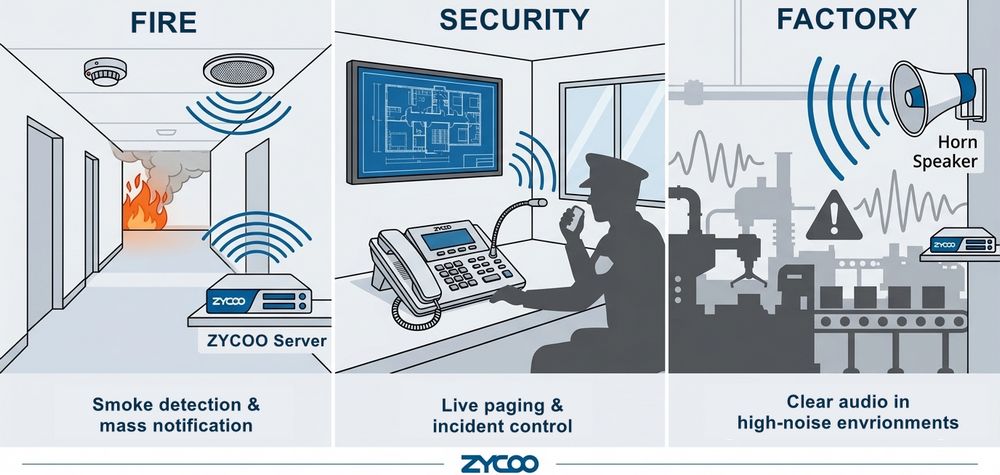
In a fire, seconds save lives. A professional emergency PA system links detection directly to communication. For instance, by utilizing ZYCOO's sensor integration solution, smoke detectors or fire panels can be linked via I/O modules to IP audio endpoints. This enables an automated trigger—once smoke is detected, the system instantly broadcasts pre-recorded evacuation instructions without waiting for manual intervention.
Zone-based broadcasting ensures that people in immediate danger are guided to safety first, while live announcements allow staff to adapt to real-time conditions like blocked exits, turning a simple alarm into a coordinated life-safety tool.
Security Incidents: Controlled and Targeted Command
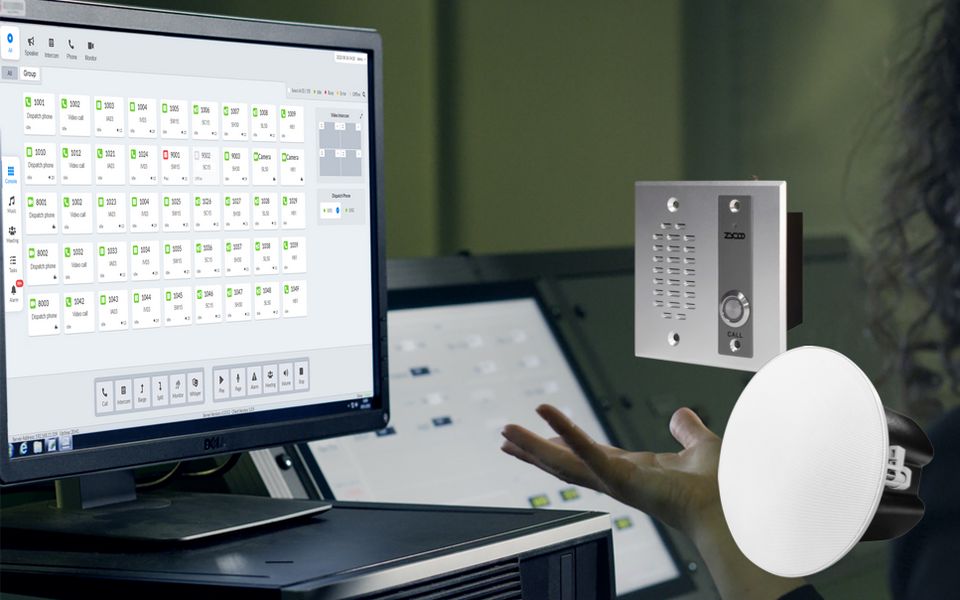
During security breaches or lockdowns, mass broadcasting can sometimes escalate panic. Precision is key. An emergency PA system allows security personnel to address specific zones using a dedicated IP Paging Console or centralized IP Audio Dispatch Console software.
This selective control allows for "silent alerts" or targeted instructions to be delivered only to relevant areas, such as a specific hospital wing or campus building. By giving operators the tools to manage instructions from a unified interface, the system supports a calm, controlled response rather than an unmanaged mass evacuation.
Industrial Accidents: Ensuring Intelligibility in High-Noise Environments
Industrial facilities are inherently noisy, and during an accident, the acoustic environment becomes even more challenging. Standard visual alarms are often insufficient; workers require clear, authoritative voice instructions to act safely.
In these high-decibel settings, the emergency PA system must not only prioritize messages but also ensure maximum speech intelligibility. (For a deeper look at managing these acoustic challenges, read our guide on effective communication in industrial high-noise environments). A properly designed system guides only the personnel in the affected sectors, preventing unnecessary production shutdowns in safe zones while ensuring that those in the danger zone receive instructions that cut through the background chaos.
Key Capabilities of a Qualified Emergency PA System
A real emergency PA system is defined more by its intelligent behavior and fail-safe logic than by simple hardware. To ensure life-safety reliability, a qualified system must integrate the following core capabilities:
Multi-Level Priority Override: This is the system's core intelligence. Unlike basic PA setups, a qualified system manages a strict audio hierarchy. Emergency triggers (such as fire alarms or SOS consoles) automatically suppress all low-priority traffic, ensuring that even during loud background music or routine paging, the emergency broadcast instantly takes full control of the audio path.
Precision Zoning & Grouping: To prevent mass panic and manage orderly evacuations, the system must support flexible zoning. This allows instructions to match the site's real-time layout, delivering specific guidance to affected floors while keeping other areas informed or clear for emergency responders.
Dynamic Voice Delivery: The system must seamlessly handle both prerecorded automated alerts and live voice announcements. In rapidly changing scenarios, the ability for an operator to override a recording with live, situational instructions is a critical safety requirement.
Versatile Trigger Integration: A professional emergency PA solution should support multiple input methods, including physical dry contact closures from fire panels, SIP-based software triggers, and manual emergency consoles, ensuring no single point of failure in activation.
Built-in Redundancy & Failsafes: Beyond standard operation, a qualified system requires backup paths for both power and network communication. In an IP environment, this often includes dual-homing or PoE backup to ensure the system remains online even if the primary infrastructure is compromised.
Comprehensive Audit Trails: For post-incident analysis and legal compliance, every event must be logged. The system should automatically record who triggered the alert, when it was sent, and which zones received the broadcast, providing a complete historical record for accountability.
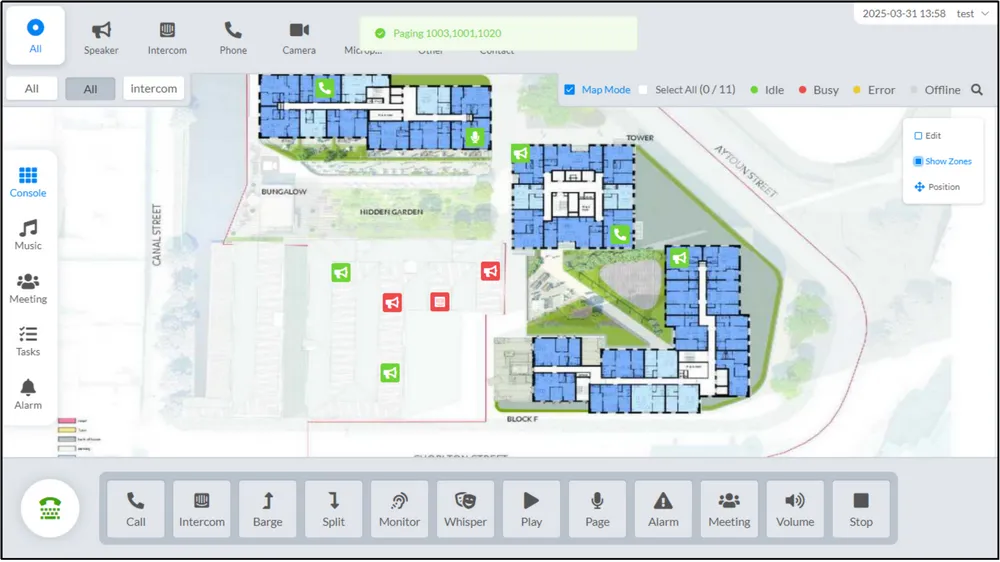
In IP-based environments, these capabilities are managed through a centralized software layer. ZYCOO's IP audio and communication platforms are purpose-built for this role, allowing emergency broadcasting to exist within a unified ecosystem alongside daily paging, SIP intercom, and VoIP telephony. This integrated approach reduces complexity by consolidating your safety logic into a single, manageable platform.
Key Considerations When Planning an Emergency PA System
Planning an emergency PA system requires a shift from hardware procurement to comprehensive risk-mitigation design. A successful deployment is measured by how the system performs under stress, not just during daily operations.
Scenario-Driven Architecture: Design should begin with potential emergency scenarios rather than a device list. Effective planning maps out the exact sequence from the initial fire or security trigger to the final automated message. If the response logic isn't defined during the design phase, the hardware remains a passive asset.
Integrated Policy Enforcement: While the system supports priority levels, the planning phase must define the Organizational Policy. Who has the authority to trigger a site-wide override? Which department gets priority during concurrent events? These rules must be baked into the system logic before deployment.
Life-Safety Path Validation: Zoning should be aligned with physical evacuation routes and fire compartments. In the planning stage, ensure that the audio coverage matches the acoustic reality of each zone, ensuring messages are intelligible even in high-noise industrial environments.
Resilient Infrastructure Topology: Beyond individual device backups, the overall network design must eliminate Single Points of Failure. Utilize looped topologies or secondary switches to maintain communication integrity, ensuring the signal path remains intact even if a section of the primary infrastructure is compromised.
Operational Readiness Testing: A system is only as reliable as its last successful validation. Planning must include a schedule for regular stress testing to ensure all integration points—from fire panels to SIP endpoints—respond correctly under simulated pressure.
Conclusion
An emergency PA system is not about sound. It's about authority, clarity, and control when everything else becomes unstable. A PA system in emergencies must act as a unified communication channel, not just a broadcasting device.
With IP-based architectures, emergency PA can be designed as part of a broader unified communication environment. Solutions like ZYCOO's IP audio platforms allow emergency broadcasting, paging, intercom, and VoIP communication to work under the same control framework.
If you're planning or upgrading an emergency PA system, it's worth designing it as a system from the start, not as a collection of devices. Just contact ZYCOO to discuss your projects.
FAQs
Q1. Do ZYCOO emergency PA systems support fire alarm integration?
Yes. ZYCOO IP audio solutions provide seamless integration with third-party fire alarm systems via Network-IO modules or SIP paging gateways. By connecting dry contact outputs from fire panels to the ZYCOO system, you can trigger automated, pre-recorded evacuation messages the instant a sensor is activated. This hardware-level integration ensures maximum reliability in life-safety scenarios.
Q2. Can emergency announcements be broadcast to specific zones only?
Absolutely. Precision zoning is a foundational feature of ZYCOO's IP Audio Center management platform. Operators can define unlimited paging groups based on floor plans, departments, or outdoor areas. During an incident, you can target announcements to affected zones while maintaining normal operations in other areas, preventing unnecessary panic and ensuring orderly evacuations.
Q3. Does ZYCOO support both pre-recorded and live emergency announcements?
Yes. ZYCOO offers a hybrid approach for maximum flexibility. You can configure the system to play standardized, high-clarity pre-recorded alerts for consistent instruction. At any moment, authorized personnel can override these recordings with live voice announcements using an IP Paging Console or a SIP-connected phone to provide real-time situational guidance as conditions change.