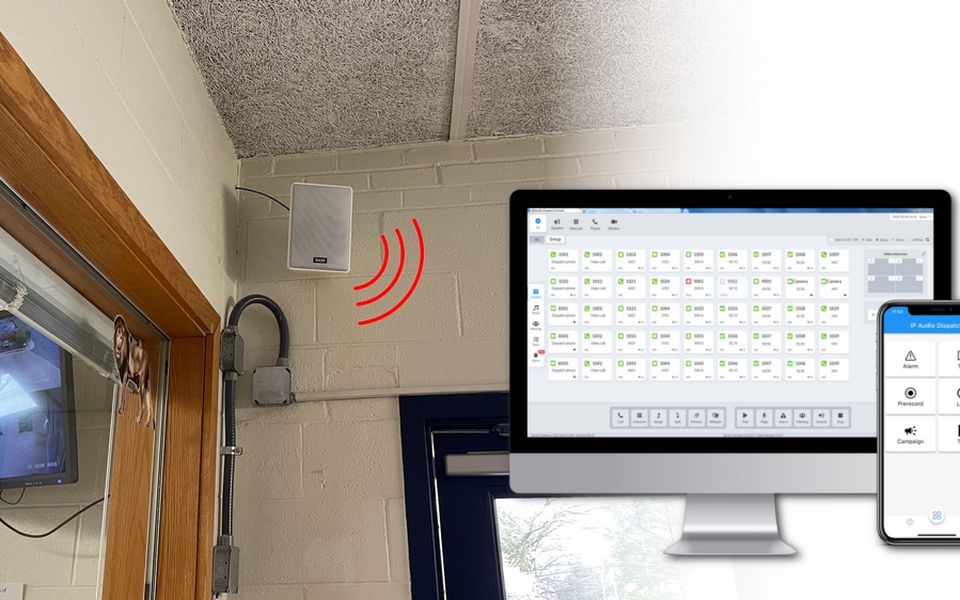
A PoE speaker draws power directly from your network switch over a standard Ethernet cable and registers with your SIP server as a named endpoint, the same way a desk phone does. That combination sets it apart from a conventional powered speaker and is the foundation for how distributed IP audio systems get managed at scale.
This post covers how PoE IP speakers work inside a SIP-based infrastructure, how they integrate them with a UC or PBX environment, and what makes them the right fit for a given deployment.
What Is a PoE Speaker?
A PoE speaker is a network speaker that receives both electrical power and audio data through a single Ethernet cable and registers as a SIP endpoint within a PA or UC system rather than functioning as a passive audio output device. It replaces the separate power supply, amplifier wiring, and speaker cable run that a conventional PA speaker requires, while also giving it an identity on the network that can be addressed, managed, and routed into calls like any other UC device.

How PoE Powers a Network Speaker
PoE, or Power over Ethernet, is defined by the IEEE 802.3 family of standards. It allows a network switch to deliver electrical power through the same CAT5e or CAT6 cable that carries data, so a single cable run handles both the network connection and the power supply. There's no separate power outlet required at each mounting location and no dedicated speaker wire back to an amplifier rack.
The amount of power a switch can deliver per port depends on the PoE standard in use. Standard PoE (802.3af) delivers up to 15.4W at the port; PoE+ (802.3at) delivers up to 30W. Most ceiling and wall-mount IP speakers operate within the 802.3af envelope. Horn speakers and other higher-output models typically require PoE+, since their built-in Class D amplifiers draw more current under load. Confirming which standard your switch supports and how much total power it can distribute across all active ports is an early step in any PoE speaker deployment.

What Separates a PoE Speaker from a Basic Streaming Device
A basic PoE audio device receives a multicast audio stream and plays it. It's just a passive endpoint with network-powered audio output. A PoE IP speaker with SIP capability works differently: it has its own SIP account, registers with a SIP server, and is addressable as an individual network endpoint. You can dial it directly, assign it to a paging group, include it in a call routing rule, or trigger it from a scheduled event. It appears in your system's endpoint directory alongside your IP phones and intercoms.
How PoE Speakers Integrate with a SIP-Based PA and UC System
SIP Registration: The Speaker as a UC Endpoint
When a PoE IP speaker powers on and connects to the network, it sends a SIP REGISTER request to the configured SIP server, whether that's ZYCOO's IP Audio Center, a third-party PBX, or any other SIP-compliant platform. Once registered, the speaker has a directory number and is reachable within the system's call routing logic. From there, the speaker behaves like any other SIP endpoint: an announcement can be triggered by dialing its extension from an IP phone, a soft client, or the management interface, with no physical access to the speaker.
The entire ZYCOO IP speaker lineup is built on this architecture. Every model registers as a SIP endpoint and integrates with the IP Audio Center for centralized management, and because they implement SIP as an open standard (RFC 3261), they also work with third-party PBX platforms without proprietary middleware.
PoE Deployment and Zone Paging
The single-cable PoE installation makes flexible zone paging practical in the first place. In a traditional wired PA system, zones are fixed by physical wiring, and changing zone boundaries means rewiring. With PoE IP speakers registered as SIP endpoints, zones are paging groups configured in software. Adding a speaker to a zone or splitting a large zone into smaller ones is a configuration change rather than a cabling job.
When a page is initiated to a group, the system delivers the audio to every registered speaker in that group at once, either as a directed SIP call to each endpoint or as a multicast RTP stream that multiple speakers join without per-device signaling overhead.
Integrating with Existing UC Infrastructure
A common concern among IT teams evaluating IP audio is whether it requires a separate network or specialist infrastructure. It doesn't. PoE speakers sit on the existing IP network and run through the same switching infrastructure already handling IP phones, access points, and cameras. In networks segmented by function, speakers can sit on a dedicated voice VLAN with standard QoS prioritization, the same approach already used for VoIP traffic, so audio quality stays consistent without requiring a new network policy framework.
The IP Audio Center gives administrators visibility into every registered endpoint, speakers, intercoms, and paging consoles, from a single platform. Endpoint status, paging group membership, schedule configuration, and broadcast history are all accessible without visiting individual devices.
Key Benefits of PoE IP Speakers in a UC Deployment
Centralized management. Because each speaker is a registered SIP endpoint, every device is visible and configurable from one platform. IT teams manage speakers the same way they manage phones, so the system can be owned and operated without specialist AV expertise.
Simplified deployment. A single PoE cable eliminates the need for a separate mains power outlet at each speaker location. In large facilities, such as warehouses, hospital corridors, multi-floor offices, and educational campuses, this removes a real source of installation cost and complexity. Running a cable to a ceiling-mounted speaker is the same task as running one to an access point or a camera.
Power resilience. PoE switches in enterprise environments typically sit on UPS-backed power circuits, which means the speakers they power keep operating through a mains interruption. For emergency notification and evacuation broadcast scenarios, that continuity isn't a bonus. It's a core requirement of the system.

When PoE IP Speakers Are the Right Choice
PoE IP speakers cover the large majority of paging and PA requirements across both indoor and outdoor environments, and the right model depends on what the space actually demands.
- In offices, classrooms, retail floors, and hotel corridors, the priority is usually clear voice intelligibility and unobtrusive background music. Compact, ceiling- or wall-mounted PoE speakers can register as SIP endpoints so announcements, paging, and scheduled audio share the same infrastructure without a secondary feed.
- In hospital corridors and wards, the requirement shifts toward dependable directed paging, calling specific staff, or broadcasting emergency instructions without disrupting quiet patient areas. The same ceiling and wall-mount speakers serve this need, with zone configuration in software making it straightforward to separate ward announcements from corridor paging.
- Warehouses, parking structures, loading docks, and other higher-noise or weather-exposed environments call for a different physical design. Horn or column speakers with IP65 ratings and higher SPL are built for sustained outdoor use. ZYCOO's SH30 horn speaker, for example, delivers up to 117dB SPL with a 70-meter effective range, enough projection for most yard, dock, and open-floor paging scenarios.
Note: For industrial plant floors or large transport terminals that require very high-wattage output across very large open areas, a network power amplifier driving passive speaker arrays provides the centralized output capacity that scale requires. In most facilities, this is a complement to PoE IP speakers rather than a replacement for them.
Conclusion
PoE IP speakers are best understood as SIP endpoints that integrate into a UC and IP PA system, not as audio devices that happen to draw power over Ethernet. The single-cable installation is a real deployment advantage, but the SIP registration, zone management, and centralized control are what make a distributed audio system manageable at scale across dozens or hundreds of locations.
Specifying the right system comes down to matching coverage needs to form factor, confirming SIP and UC platform compatibility, and verifying the PoE power budget against the switch infrastructure in place. Get those right, and the rest of the deployment, from zone configuration to day-to-day management, follows from an architecture that's already built to support it.